The incredible Grace Tame recently did an interview on the podcast The Imperfects, and it reminded me all over again that we need to keep talking about this. Thank you, Grace!

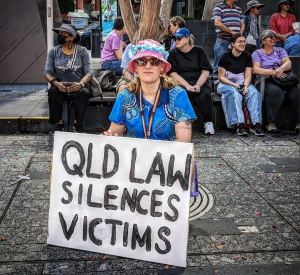
It may be 2024, but in Australia, most states and territories still do not allow victim-survivors of sexual assault and domestic violence to speak the truth.
Vulnerable people are silenced by the very legal system that claims it wants to protect us.
The legal system disproportionately favours the person with more money and power. That usually means abusers, who:
- Have often spent years controlling or withholding household finances
- Typically earn more thanks to the gender pay gap that still exists in Australia
- Have the power of a respected position in the community, or
- Are confident that their victim is not legally allowed to speak up about what they did.
With pro bono legal services and DFV support services across the state already stretched beyond capacity, vulnerable women, non-binary people, trans people, and children, are being left to fend entirely for themselves.
The current legal system in Queensland perpetuates abuse. Because it’s easier for an abuser to control a person when they know that person cannot “out” their abuser.
Read on to find out what laws we need to change.
What about “false reports”?
Whenever we talk about safety for women/non-binary people and children, politicians and men’s advocates will claim that the law of silence is preventing “false reports” that could “ruin a man’s life”. A shocking 40% of Australians say they don’t believe women who share how they have been sexually assaulted or abused (ANROWS, 2021).
But the fact is, research in multiple studies shows that only 5% of rape cases are rejected by courts. (See the Victorian Police factsheet for more detail.)
And when we silence women who tell the truth about what violent men did to them or their children, it leaves those violent men free to murder them.
Sadly, 59 women have been killed by men in Australia this year alone, as of 14 September 2024.
(For details, see reporting by Sherele Moody, and Fight Against Femicide, and Our Watch.)
So because we know that we can believe victims when they share their experiences, and we know that silence often leads to death, then the following are the main laws we need to change in Queensland, so that they can share without being sued or even jailed.
Domestic violence protection orders (DVPO, IVO)
Domestic violence protection orders (DVPOs) or intervention orders (IVOs) are meant to get victims out of a bad situation and protect them from abuse, but all too often, victim-survivors report that the court condemns them for seeking help.
The Queensland Magistrates Courts and District Courts require confidentiality by victim-survivors in DFV court cases to get a domestic and family violence (DFV) protection order, under section 159 of the Domestic and Family Violence Protection Act 2012 (Qld).
This means as soon as someone applies for a protection order, they cannot tell others about:
- What happened to them
- Their application for a protection order
- Who the abuser is.
In this way, Queensland courts appear to care more about protecting the identity of the abuser than about letting the victim-survivor seek support or protect others. Their website says courts are closed to protect victims, but is that true?
The court effectively grants an abuser the legal right to silence their victim. Is that just?
And then there’s the fact that going to court is:
- Terrifying and re-traumatising…
- Too expensive for many women to afford (hello again, gender pay gap)…
- Completely inaccessible for non-lawyers (unless you speak fluent Legalese)…
- Takes nearly a year to get a protection order, and longer for some cases…
- Repetitive, because Queensland protection orders expire after 5 years, and many say it’s quite difficult to have the court renew them…
Oh, and as a bonus, Queensland Parliament has been giving themselves a big pat on the back for criminalising coercive control, and the legislation says it came into effect earlier this year… But the police say they can’t legally enforce that law until late next year (2025). What the?
Meanwhile, perpetrators still feel free to make false claims, such as saying their victim wanted to be abused… Perpetrators routinely make counter-claims that their victim abused them, a phenomenon known as DARVO. Because part of the perpetrator’s mindset is narcissist traits: only caring about getting they want, and a willingness to “spin the truth” to win.
And statistics show that in DFV murders, men most often kill in retaliation when their victim calls the police or applies for legal protection. Check out some of the recent horrifying cases from Australia that we didn’t see reported in the media on the podcast I Think My Fridge Is Haunted: https://youtu.be/lcsDfeVM2wg?si=qSXldMnwMIaVpd1K
Parenting orders from the Family Court of Australia
Under Australia’s Family Law Act 1975 (Cth), parents can’t tell others about parenting orders from the Family Court. The court claims this aims to protect the privacy and welfare of children involved, and to protect “sensitive” family matters from public scrutiny.
But in reality, it means that violent men who have restrictions on their custody can be confident that almost nobody knows that they aren’t allowed to see their kids, or why. This causes incredible danger to the children of being abducted or harmed, because no one knows that someone shouldn’t be allowed to pick up the kids from their school, kindy, birthday parties, whatever, etc.
And because the Family Court process takes so long (about 12 months to get initial “interim” orders, longer for permanent “final” orders), this prevents those going through the process from being able to consult others and obtain more evidence about the other parent. This can make it harder to prove to the court that one parent is safer to have custody of the kids than the other.
These sections are the main problems:
- Section 121 of the Family Law Act is about confidentiality. It says you can’t publish details of the case (e.g. make social media posts about) or broadcast details (e.g. podcast, radio) that could identify the children or the parties in the case (the parents or guardians).
- Section 10A of the Family Law Act says the court must put the best interests of the child first when they make orders, which includes making sure that the orders are discussed sensitively. As a normal person, not a lawyer, I don’t know exactly what this means. But lawyers have said the court uses this section to tell parents not to discuss their court case or parenting orders with anyone other than their lawyer (if they have one), the other parent, and the court.
- Most parenting orders also include a clause that says parents cannot talk with their children about the court case or the orders, cannot allow children to see the orders, and more restrictions like that. The courts say this protects children from being involved in “adult issues”. In reality, it makes it more difficult for children to understand, because parents who are following the orders have to do verbal gymnastics to answer their children’s natural questions:
- “Why am I going to the other house today? Tuesdays I’m normally with you…”
- “Why do they always have that supervisor person with them when I go play with them now?”
- “Why do I have to go to their house? I don’t want to!”
Defamation laws in Queensland
In theory, the Queensland Defamation Act 2005 is supposed to protect individuals’ reputations, balancing this against the right to freedom of “expression”. (There’s no legal right to “freedom of speech” in Australia, like there is in the USA.)
But in reality, lawyers can strategically use defamation claims to intimidate or silence victims, rather than to address genuine harm to their clients (abusers). This silences victims of domestic violence, sexual assault, stalking, and other criminal offences.
Many abusers can afford to hire a lawyer – thanks to their years of financially controlling a victim, and thanks to earning more through the gender pay gap – and their victim-survivors often cannot afford to hire a lawyer.
The worst part is that the abuser usually doesn’t even need to actually take the victim-survivor to court, where a judge might dismiss, or at least question thoroughly, an abuser’s case.
Speaking with victim-survivors, we know that when most women see a cease-and-desist letter that mentions defamation, they are immediately triggered into flight or fawn for their own survival.
They stop talking about the abuse, which gives their abuser more freedom and safety to keep abusing them.
This misuse of defamation laws doesn’t just hurt victims – it also makes it harder for the media and the general public to expose and discuss significant issues like corruption or misconduct.
Court rules about communication in Queensland courts
One of the main rules about lawyers and courts in Queensland is that everyone has to ask for the court’s permission to do anything, and when communicating with the court to ask for permission to do things, parties must copy in the other party’s representative.
See the regulations in the Uniform Civil Procedure Rules 1999 (Qld):
- Rule 5 is about seeking the court’s permission.
- Rule 6 is about both serving documents to all parties involved, and copying in legal representatives when contacting the court.
Translation: Victim-survivors must copy in their abuser or their abuser’s legal team, when contacting the court about their case where they’re trying to get freedom from their abuser.
Even worse, in the Queensland Magistrates Courts and the Family Court (Federal Circuit and Family Court of Australia) in Queensland, the court expects parties to file joint motions. See these regulations:
- Federal Circuit and Family Court of Australia (Family Law) Rules 2021: Rule 4.01 is about the requirement for parties to file joint motions when possible.
- Magistrates Court Rules 2014: Rule 2.10 is about the expectation for joint applications.
Translation: The courts expect victim-survivors to get their abuser to agree to anything they need to ask the court, before they can ask the court.
I know it’s pretty unbelievable, but it’s true.
Now, both the Magistrates Court registry (the court reception desk, basically) and the Family Court registry have told victim-survivors that “of no, of course you don’t need to copy in your abuser”, but the rest of the court staff disagree.
I don’t know what anyone is supposed to believe when dealing with the legal system in this state. It’s bonkers.
So it’s no surprise that because speaking the truth currently means the victim-survivor is at risk of being sued or literally put in jail, most victim-survivors are too afraid to speak out.
Not good enough, Queensland.
It has to change.
 TJ Withers
Pingback: Books every Australian man should read in 2025 | TJ Withers