Adolescence “uncovers” the misogyny and violence that women have been talking about for decades

I forgot to post this one in March when I drafted it! Everyone, pretend you already saw it in March! 😅
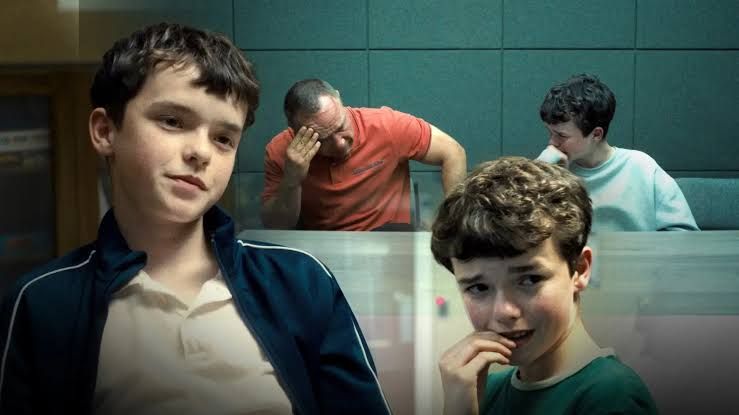
Image source: compilation of stills from Adolescence on Netflix

Netflix’s popular new 4-episode show, Adolescence, is being hailed as a masterpiece in unveiling incel culture in young boys. And I agree, it is a brilliant performance by talented actors, and it is well-filmed, with each hour -long episode being filmed in one shot.

But even the show’s male producer, Stephen Graham, doesn’t seem to understand how his own misogyny creeps into his performance as Jamie’s father on the show.

In an interview with Rolling Stone, Graham claims that his character is just an ordinary Dad, “a hard-working man” who works long hours.

“I didn’t want him to be a violent dad who would raise his hand to his children,” says Graham.

So why do we see this supposedly non-violent male character, being abusive against his wife and children throughout the series, before he violently attacks a young man in public in episode 4?

If this is what the “good guys” think makes a good father… If this is the type of non-violent man who “couldn’t stop” his son from becoming a murder?

Or – more likely – is this series just one more example of a man looking for someone else to blame for men’s violence?

In fact, social media itself isn’t the only scapegoat in this series.

Katie, the girl who was brutally murdered by Jamie, is blamed for her own death.

The detectives and Jamie’s family claimed Katie was “bullying” Jamie, when all she really did was say “no” when he asked her to go out with him, and posting a single emoji – albeit loaded with meaning – on one of Jamie’s posts.

Yes, and this gets cleared up fairly early in the series: In Episode 1, CCTV footage shows Jamie and Katie in an altercation. She pushes him, and he pushes her, and then he stabs her repeatedly.

What’s being said on the internet is not new. This was first all said in grumbling tones by men at the pub, and then shouted at women when those men stumbled home.

Social media isn’t the problem.

Men’s violence is.

Take action against men’s violence today:

  • Sign the petition to the federal government petition to STOP abusers from suing victims who dare to report to police or speak up to warn others.
  • Donate to frontline services who are actively helping women and children leave – and stay out of – violent relationships. I recommend DVConnect for their crisis helpline, RizeUp Australia for providing accommodation and emergency furniture, BRISSC for free counselling and art therapy, and Women’s Health and Equality Qld (WHEQ) for community events and education.
  • Loudly disagree whenever you hear victim-blaming language. (No matter who’s saying it!)
  • Hold boys accountable whenever they hurt girls or women.

Stay safe, friends. xx TJ
Family Court cases you have to read to believe: Josey & Meibos

The Family Court of Australia has made some really odd decisions in the past decade, which it uses as precedents when making decisions now.

There are a long list of cases that will blow your mind, and today, here’s just one of them.

In Josey & Meibos [2009] FMCAfam 470, the Family Court harshly reprimanded a mother when she changed her kids’ school to try to keep herself and her children safe from their father, who had a history of violence and anger against them.

Not only that, but the court ordered her to re-enroll the kids in their original school and creche, and ordered the mum to make all decisions like this jointly together with the dad in future.

Continue reading

Election: What political parties did when 4 women died in one week in Australia

Horrifically, during 2025’s Australian federal election campaign cycle so far, 4 women have died in one week (see Women’s Agenda).

A 45-year-old woman was murdered and her two young children grievously injured in Sydney.

Louise Hunt (42 years old) was allegedly murdered by her husband in Geham, Queensland.

Kim Duncan (65) was shot in her own living room.

And Claire Austin (38), who died in hospital after fleeing from a man believed to be her abuser. She had a court date set to get an apprehended violence order (a restraining order / protection order).

The men involved were all known or suspected of being violent or abusive before killing these women.

So with the election on this Saturday, and early voting happening at record levels, we should all ask ourselves: What are the political parties doing to keep women and children in Australia alive?

It’s a huge question, but the response from the Big Boys, Peggy Sue (Peter Dutton) and Albo (Hon. Prime Minister Anthony Albanese), has been tiny, and tokenistic at best.

In contrast, the response from The Greens and some keys independents has been massive, and meaningful for victim-survivors.

Want to keep women and children alive? Here’s who you should vote for in the Australian election.

Let’s break it down by political party.

What The Greens are doing to stop domestic violence

The Greens already do a lot to help victim-survivors of domestic and family violence (DFV) and advocate to prevent further men’s violence.

My local Greens MP Max Chandler-Mather puts a huge amount of their own salary into providing free community dinners every Monday, free school breakfasts, and advocating for housing for people at risk of being evicted.

They work with residents to fight against big developers who are trying to force them out of their own homes.

They were in the mud during the floods of Cyclone Alfred, making sandbags together with volunteers, and helping people get back on their feet.

They’re campaigning to stop pubs and clubs from adding more pokies, because we know that along with alcohol, gambling and debt are some of the most common factors in men choosing to commit violence against women.

They even have a free food pantry at their office, so you can come for a free meal, and ask for help with housing or homelessness.

Looking to the future, The Greens have launched a $15 billion comprehensive plan to address the national crisis of family, domestic, and sexual violence.

And it’s all funded by making the big corporations and mining giants pay tax – because they currently pay less tax than I do as a student teacher and support worker.

So the Greens’ plan will protect women and children, without any tax hikes against vulnerable workers like women, non-binary, and child workers.

But they’re not waiting until election day to act!

Continue reading

The Better Blokes podcast is the Aussie version of Andrew Tate, but less intelligent

If you’re ready for a hilarious and engaging listen this weekend, start with Pod Like A Girl’s breakdown of the charity fails by “The Better Blokes” podcast.

You can listen to Pod Like A Girl on all the podcast apps, or visit the website to listen to it there:

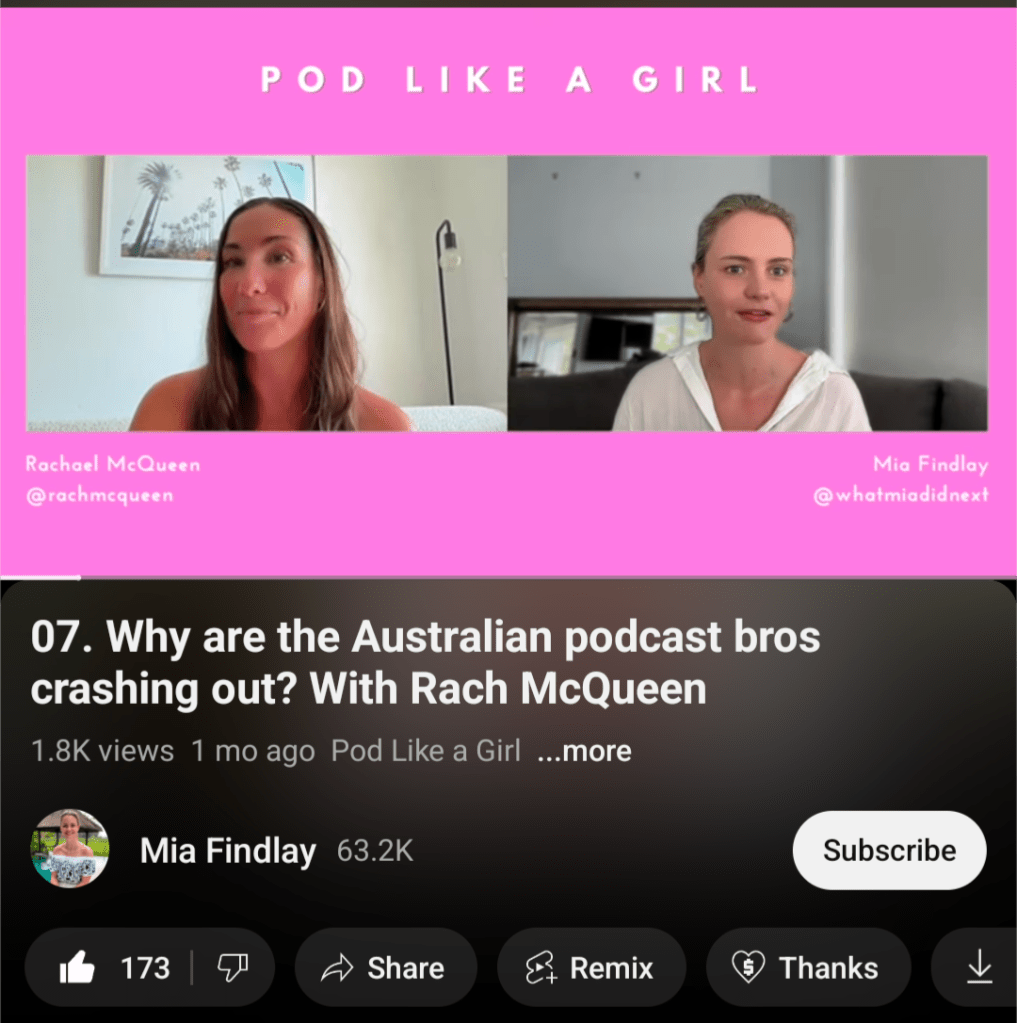
Pod Like a Girl: 07. Why are the Australian podcast bros crashing out? With Rach McQueen

Or you can watch this important conversation with video on YouTube:

Image from video of Mia and Rach speaking about how the Better Blokes project has been encouraging men's violence against women.

Or you can even download the mp3 file to listen to it another way.

Full disclosure, it’s not just amazing, it’s also enraging, but only because we’re talking about the unashamed misogyny and idiocy of these two man childs.

And Rach and Mia are absolutely the right women for the job, because they’re intelligent and informed.

They’ve also spent years advocating to eliminate misogyny, sexism, and violence from Australia’s culture – and advocating for victims of this misogyny, which we know also harms men themselves.

The men who are going to The Better Blokes project for advice are more likely to be harmed, not helped, by what these blokes are spouting.

It’s the Aussie brand of the Andrew Tate manosphere, where men are encouraged to be a real man, and women are NOT welcome.

Like their videos telling women to “shut the f*** up” and let men speak (direct quote). 🤢 🤮

Which is a problem, because their governing legal documents, their charity charter, says they exist to improve men’s mental health… Not to indoctrinate men with misogyny and encourage violence against women, non-binary people, and even kids.

Cover image of the Better Blokes podcast.

So are they actually helping men’s mental health?

Let’s see…

Continue reading

Aussie kids say Family Court was meant to help but “they did the opposite”

I just read the most heartbreaking message from 41 children who have been ignored and unheard when going through the Family Court of Australia.

One, 15-year-old said they felt “squashed”.

I just had to do what I was told and be quiet and suck it up, even if it wasn’t what I wanted.

Two sisters were ordered by the court to spend time with their father, even though they told the court they didn’t want to because they would not be safe with him. One of the sisters said:

That was always one of my biggest regrets because I’m like, maybe if I had said something differently, or emphasised it more, they would have understood what I was trying to say and actually listened… It wouldn’t have made such traumatic memories, which happened afterwards, when we were forced to see him.

The main themes they highlighted match previous research that looked into the fundamental flaws in Australia’s national “child-centred”, “DV aware” court.

For example, studies about the Family Court process and judges’ decision-making have found that:

  • “The courts are seemingly prioritising protection of the child from the risk of psychological harm by the mother due to her failure to facilitate meaningful ties with a father over the risk of alleged physical or sexual harm by the father.  We see this as a serious concern.” (Easteal, Prest, & Thornton, 2019)
  • There is a “lack of fit” between the types of cases that end up in the Family Court, which “are invariably complex, and likely to involve allegations of domestic violence and/or child abuse, mental health concerns, high conflict, and substance misuse”, and the court’s repeated focus on shared parenting by both parents, “reflected in decisions that appear not to reflect the system’s overarching principle of the ‘best interests’  of children and may also pay insufficient attention to the safety of women and children.” (Laing, 2017)

So what is the Family Court of Australia actually supposed to be doing for children, and why is it refusing to meet its legal obligations?

Continue reading

Books every Australian man should read in 2025

Welcome to 2025.

It’s harder to say “happy new year” when you remember that 101 women were killed by men in 2024 (Femicide Watch Australia, 2024).

It might not sound like a huge number, until you compare it to the 46 women who were killed by men in the 2022-23 financial year (AIHW, 2024).

Men killing 101 women in 12 months is horrific because it is a doubling of violence against women in Australia.

Domestic and family violence is a national emergency, with 1 in 4 Australian women having experienced violence from a male partner (White Ribbon, 2024).

With that in mind, I read the following books last year, and I believe they would help any Australian man who wants to understand the current war on women and children in our nation.

More importantly, this information can help any person who wants to help us end the war on women.

I was thoroughly impressed by the way these writers gathered measurable data and research from all around Australia and sometimes internationally.

I’m sure you’ll find the statistics astounding – because I did, and I’ve already been reading on these topics for 20 years.

For example, for women with disabilities, the rate of men’s violence is doubled (Scope Disability Services Australia, 2024).

A note on gender references: All references in this article to “women” include trans women. Much of the data on “women” also includes non-binary people, who are routinely marked as female “for insurance purposes”.

Continue reading

Free Lesson Plan: Unpacking the patriarchy in context (Year 10 English)

This is a lesson plan I wrote in 2024, to align with the F-10 Australian Curriculum for an English class. I wrote the plan for one of my university assessments, so I’ve put the research receipts down the bottom of the page if you want to look closer into the background information.

I’m just a student teacher studying my Master of Education, so please feel free to provide kind, specific feedback. 😎

How to use this lesson plan: I designed this with multiple parts that you can mix and match if you want to run a single lesson … or you can run all parts over a few classes or a double period.

Duration (mins): 70 minutes per class, designed for 2 class sessions or a double period.

Resources needed:

  • PPT and projector
  • Downloaded video clips (for when the WiFi fails us)

Before we get into the lesson plan, though, I just want to clarify one very important question…

Why learn about the patriarchy in English class?

Understanding how the patriarchy perpetuates domestic and family violence (DFV) in Australia is a key part of being an active and informed citizen in 2024. Students are learning empathy as part of the personal and social capability general capability (GC) in the Australian curriculum, and we know that students can build empathy and advocate for others by learning about past and present human rights violations. And because adolescent students are often having their first romantic and sexual experiences, talking about the red flags of abusive relationships helps to protect them from harm.

In a future post, I plan to show you a lesson plan for a Year 10 Psychology class, about how harmful messages in patriarchal societies have affected most people’s implicit biases. Learning to spot our own implicit biases is one of the easiest places to start when learning self-awareness and learning to create psychological safety in our society.

Content for today’s lesson

This lesson focuses on spotting and analysing literary devices and understanding how audiences view a text differently depending on their social and political context. We’ll look at the song Labour by Paris Paloma, which I love as a teaching tool for two reasons.

image shows thumbnail from YouTube video for the official music video of the song Labour by Paris Paloma, posted March 2023.

See YouTube for the official music videos for
labour and cacophony (labour)
by Paris Paloma

First, many students already know this song because it went viral on Tiktok (and then on the rest of social media). So they’re familiar with some of the lyrics, making more brain space available to do the “thinking” analysis tasks of this lesson.

    Secondly, it’s often easier to spot literary devices in poetry texts than in prose like articles or novels, and song lyrics are a highly-effective form of poetry. So teaching Labour as a poetry text means again, students can put more energy towards learning or remembering the content.

    If you’re an education student like me, this reasoning provides evidence of you meeting Australian Professional Standards of Teaching (APST) number 2: knowing the content and how to teach it.

    Continue reading

    Bumble’s bumble: Worst Advertising Campaign of 2024 Award

    The second I saw this ad campaign by Bumble, I immediately uninstalled the app (I never use it anyway) and submitted a 1-star rating everywhere I could, and so did thousands of others.

    Here’s why.

    Note: This article refers to “women and other genders” and to “non-men” in an attempt to represent the reality of as many people as possible. Anytime I’ve written “women”, “trans women”, “trans men”, or “non-binary people”, know that I’m trying to remind people of a gender fluid spectrum, rather than trying to call out specific genders.

    How Bumble offended every non-man in just 2 days

    Bumble launched their “celibacy is not the answer” ad campaign in early May 2024, and it’s worse than anyone expected.

    Example 1 from Bumble's ad campaign in May 2024 says you know full well a vow of celibacy is not the answer.
    Continue reading