If you’ve ever had *that* discussion with a colleague about how to use punctuation in bullet points or numbered lists – and I know you have, because you asked me to post about it – then you’ll know it’s a controversial topic.
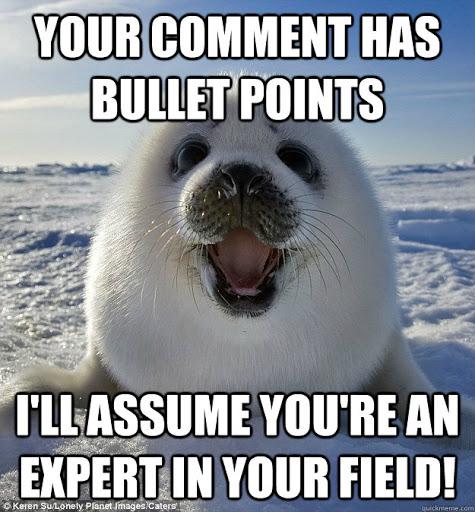
Image source: Photo by Karen Su, Lonely Planet; meme from QuickMemes.
That’s why it’s spelled out in most of the major style guides. This post details the punctuation rules for the style guides I’ve written for various companies, based on AP Style (used by journalists), Macquarie style, Oxford style, and a few others.
Why care about whether your bullet points and numbered lists have punctuation, “and/or”s, and the like?
Because all of this affects readability, and y’all know, we live in the Golden Age of Skimreading. Readability is king.
The Oxford comma is when you put a comma before “and” or “or” or another conjunction, at the end of a list of three or more items.
e.g. I like to read books, write books, and talk about books.
e.g. I like to read, write, but not talk about books.
The Oxford comma is a special comma guidelines used by a lot of style guides here in Australia, including the style guides at QSuper and Canstar, which I wrote during my time there.
Why use the Oxford comma?
There are three reasons to use the Oxford comma:
Makes a sentence clearer if there are multiple “and”s.
Without the comma, the end of the sentence can become the observer/receiver of the sentence (incorrectly).
Without the comma, the end of the sentence can become a descriptive clause (incorrectly).
Image source: SayingImages.com
Using commas to make sentences easier to read
First, the Oxford comma is helpful because it separates the last item in the list from the second-last item, making the sentence clearer.
Here’s a comparison of using the Oxford comma vs not using it:
e.g. With the comma: QSuper now offers multiple different types of insurance, including death, total and permanent disability, and income protection cover.
e.g. Without the comma – less clear: QSuper now offers multiple different types of insurance, including death, total and permanent disability and income protection cover.
Using commas to keep sentences correct
Secondly, the Oxford comma is helpful because without the last comma, it can seem as if the end two items of the list are the observer or receiver of your sentence. An example can explain this better than I can:
e.g. With the comma: I love my pets, family, and friends.
e.g. Without the comma: I love my pets, family and friends. >>> You are actually telling your family and friends that you love your pets, i.e. “Family and friends, I love my pets.”
Thirdly, the Oxford comma is helpful because without it, it can seem as if the end two items of a list are describing the rest of the sentence (“a descriptive clause”, if you want to get nerdy).
e.g. With the comma: I love my pets, Mum, and Dad.
e.g. Without the comma: I love my pets, Mum and Dad. >>> I am saying that Mum and Dad are my pets, and they would really not be happy about that.
Why is it called the Oxford comma?
Now let’s get really nerdy! The “Oxford” comma is called by this name because it was traditionally used by the Oxford University Press editors and printers.
They also called it the “serial comma” because it’s used for lists, but since “serial” makes me think of serial killers, I don’t use that name.
Now, the Oxford Style Guide themselves dropped the “requirement” for an Oxford comma in all cases in 2011, and made it a guideline instead.
But there are still got many good reasons to use the Oxford comma, so I’m happy it’s sticking around.
As far as I’m concerned, there are three scenarios: using the Oxford comma correctly, not using the Oxford comma and being wrong.
(Joke. But seriously, it physically hurt me not to put the comma there.)
(C) TJ Withers-Ryan, 2022. Please credit me when you repost or share. Thanks!
This is probably the most hilarious post we’ll ever see on this page – and I’m keeping it PG on purpose so just… What can I say?
Think clean.
Image source: icanhascheezburger.com
Is it ‘bare with me’ or ‘bear with me’?
“bare” = not clothed, simple, uncovered.
e.g. They bared their soul with me by talking about their childhood, and I appreciate it.
e.g. They got bare with me, and we went skinny dipping.
So if we were to say “bare with me”, just make really, really sure that you actually want something to be undressed or uncovered…
“to bear” = to be patient / to hold up under pressure / to hold on during adversity.
e.g. We’re asking you to bear with us while we make our decision.
e.g. I can’t bear the humiliation.
So if we were to say “bear with me”, we would be asking someone to be patient with us while we talk something through with them, take a while to find some information for them, ask them more questions, etc.
(C) TJ Withers-Ryan, 2022. Please credit me when you share or repost, thanks!
When I used to run business writing training for teams at QSuper to learn the company’s written style and tone of voice, people always asked me to explain where the full stop goes when you have other punctuation at the end of a sentence.
It’s also a common mistake I’ve seen people get wrong a lot, whether they’re writing for business or fiction authors.
This mainly happens with brackets and quotation marks, so that’s what I’ll cover here. Comment down below if you have other full stop questions you want to ask about!
Image source: icanhascheezburger.com (Excuse the lack of full stop in this meme. 😉 )
Where does the full stop go?
A full stop always, always, always goes at the end of a full sentence.
So you need to ask yourself, is the thing inside the “quotation marks” or (brackets) or other punctuation a full sentence on its own?
Does it make sense if you put it alone and give it its own full stop?
e.g. When I used to run training for the company style guide (which I helped write), I had a lot of fun.
>>> Can you see how (which I helped write) is not a full sentence on its own? Writing (Which I helped write.) wouldn’t make sense.
So the full stop needs to go at the end of the sentence, not within the brackets.
Where does the full stop go, inside or outside the quotation marks?
If the quote is a complete sentence on its own, it gets its own full stop within the quotation marks.
e.g. The Minister said, “Super is awesome.”
Where the quote is just a clause – not a full sentence – the full stop goes at the very end, after any quotation marks or brackets.
e.g. The Minister said the superannuation industry was “changing quickly”.
>>> “changing quickly” is not a full sentence, so the sentence needs to go outside the quotation marks.
Where does the full stop go, inside or outside the brackets?
If the bracketed phrase is a complete sentence on its own, it gets its own full stop inside the brackets.
e.g. QSuper offers different types of insurance. (At the time of writing, these are death cover, TPD cover, and IP cover.)
Where the quote or bracketed phrase is just a clause – it’s not a full sentence – the full stop goes at the very end, after the brackets.
e.g. QSuper offers different types of insurance at the time of writing (death cover, TPD cover, and IP cover).
(C) TJ Withers-Ryan, 2022. Please credit me when you share or repost, thanks!
I had to research this one myself a few years back, because I was always taught “different to” was correct, but I hear people all over the place saying “different than”, “different from”, etc.
So here we go, let’s word nerd out – here’s what the experts say about how you can use the word “different”.
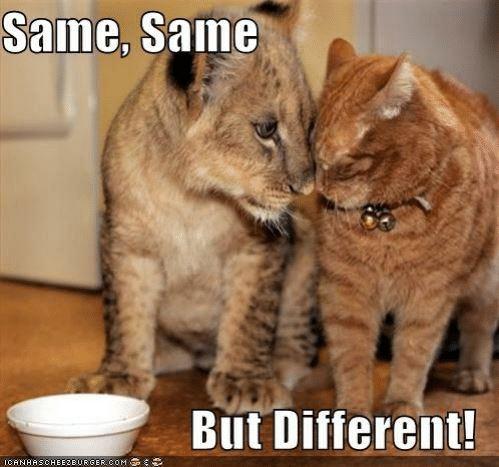
Image source: icanhascheezburger.com
Is it different from, different to, or different than?
If you’re aiming to sound correct to most of the world, both “different to” or “different from” will be good. And “different than” will sound incorrect unless you are speaking specifically to an American audience.
All of the below examples are therefore correct usage according to the modern standard:
e.g. Our app works differently to our competitors’ apps, and that’s why it’s more stable than other apps.
e.g. Our ways of working are different now to what it was like before the COVID-19 pandemic.
e.g. The QSuper Lifetime investment option uses an investment strategy that’s different from our Balanced or Aggressive investment options.
Why different to and different from are both better than different than
When you Google grammar tips, add the word “Australian” or even “Oxford English Dictionary” to your search so you can get tips that are valid for Australia, rather than getting a bunch of American results that don’t apply here.
First, I took a look at what the Australian Writers’ Centre says. They said you can technically use any of three prepositions “to, from, than” with the adjective “different”.
But they did point out that “different from” is most commonly used around the world; “different to” is most common in Australia and the UK; and in the USA they also use “different than”.
For the history, apparently “different to” was the earliest version used, and before the 1700s, you could also say “different against” – but obviously we don’t say that anymore.
Lots of us were trying to stay active all pandemic, even though we were stuck at home – but just as importantly, is your writing active or passive?
And why does it matter?
What is active and passive voice?
Active voice means that your voice (the subject of the sentence, usually a noun is at the start, followed by what your subject is doing (the verb), then the object the verb is happening to.
e.g. We (subject) offer (verb) default insurance (object) to eligible members (secondary object).
Passive voice means the object (the thing it’s happening to) is up front. This type of sentence is usually missing its subject (the person doing the thing).
e.g. Default insurance (object) is offered (verb) to eligible members (secondary object).
How do you know if you’re using passive voice?
You can tell if a sentence is missing its subject — and is therefore in passive voice — because you can add “by zombies” to the sentence and it will still make sense.
Image source: Wikipedia
e.g. Default insurance (object) is offered (verb) to eligible members … by zombies.
Why does everyone say you should write in active voice?
Now, here’s why you want to write in active voice whenever possible:
1. Readability. I like it when skimreaders (a.k.a. every busy person ever) can easily understand what I’m writing about. Readers’ brains like simple sentence constructions that are in active voice.
2. Less work for your brain. The active voice construction “subject, verb, object” is the first and most common one taught in English-speaking schools, so it’s harder work for your brain to remove the subject and construct a passive sentence.
3. Reduce risk of RSI. Passive voice sentences are typically much longer, with more words, which means more typing and more repetitive strain.
So save your brain and your wrists from the zombies, and write in active voice.
Common misunderstandings about active voice
One thing I’ve noticed is that sometimes writers, reviewers, and even less-educated editors will talk about “active voice” when they actually mean to talk about one of the 12 tenses in English — “present tense”, “future perfect tense”, etc.
Drives me nuts. Everyone thinks they’re a scholar, but they don’t have the degree or the self-education to give them a real foundation.
The difference between voice and tense is that while the voice changes the whole sentence structure, a tense only changes the verb (the doing word) or the adjective that describes that verb.
(More on how to use the tenses in a later post, if you want to get even more word nerdy.)
So if someone says to you, “This sentence needs to be in active voice.” and you can see that the structure is actually correct — subject, verb, object — then that someone is trying to tell you something about the sentence but it has nothing to do with active or passive voice.
You’ll need to ask that person questions to find out what they actually want to change in your sentence.
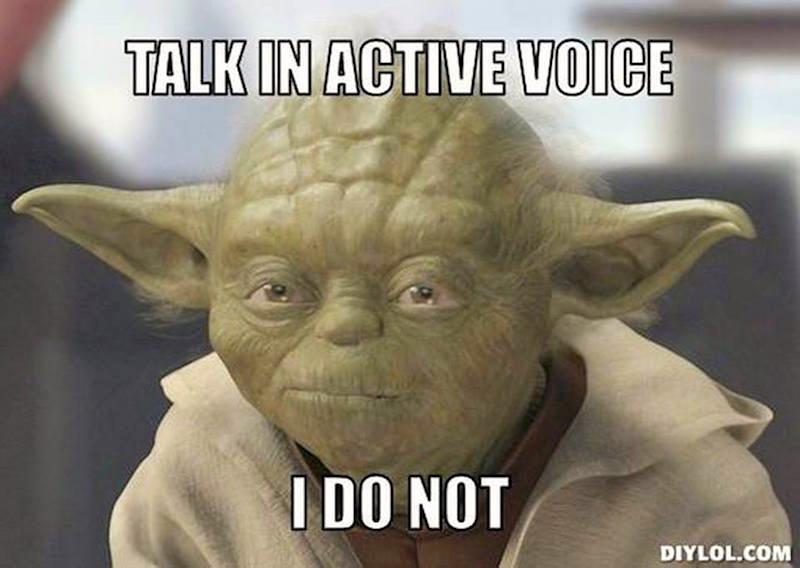
Image source: DIYlol.com by Arnold Zwicky’s Blog
(C) TJ Withers-Ryan, 2022. Please credit me when you share or repost, thanks!
1. Does a person/company/group own something? Use an apostrophe
e.g. We need your driver’s licence as proof of identity.
e.g. We are currently reviewing all customers’ accounts.
e.g. Your team’s efforts should be recognised.
e.g. We won Rainbow Unicorn’s Best Value Award.
e.g. What about James’s report?
Exception: its and your are also words for ownership, but they don’t use apostrophes (compared with it’s and you’re).
You can work out whether you’re writing the exception or whether you need an apostrophe by checking if you can replace the “its” or “your” with a name and apostrophe. If you can, then it’s about ownership.
e.g. The Group has expanded its/your working-from-home capability this year.
>>> This could be replaced with a name and apostrophe, e.g. The Group has expanded Bob’s working-from-home capability this year.
So because the sentence still makes sense after replacing the word, so “its” or “your” would be appropriate.
2. Is it a contraction (two words stuck together and shortened)? Use an apostrophe to glue the words together
Contraction are words that are stuck together and shortened, such as we’ve – a contraction or “we have”.
e.g. At our company, we’ve been looking after members for over 100 years.
It’s = a contraction of “it is”.
So if you can replace “it’s” with “it is”, and the sentence still makes sense, you’re on the right track.
e.g. At our company, it’s all about putting members first.
>>> At our company, it is all about putting members first.
You’re = contraction of “you are”.
e.g. You’re going to need to check your super balance.
3. Is it a plural? No apostrophes
e.g. PDSs, FAQs, MPs, 1980s, he’s in his 50s.
I cringe every time I go to my favourite fish-n-chip shop because the lovely owners’ sign says they have “new special’s every week”. (And yes, we do occasionally chat with them about their sign, but the owners are just too sweet and I always end up hearing all about their grandkids and asking them for advice about my daughter’s toilet training, because y’all know – relationship is more important than grammar.)
4. Is it another type of abbreviation (not a contraction)? No apostrophe
e.g. When we’re referring to legislation, it’s “Cth” not “C’th”.
I think that about covers it (not “cover’s it”), but if you have questions or exceptions you’d like to talk about, please comment!
(C) TJ Withers-Ryan, 2022. Please credit me when you repost, thanks!
Why do we hyphenate some words and not others? Is it the death of the hyphen? Not quite yet.
In 2019, some AP Stylebook updates caused an uproar in the editing world – and it’s always funny when writers riot (check out Twitter if you don’t believe me).
The uproar was because the AP editors reduced the number of words they recommend have a hyphen and said the English language changes over time.
After all, we don’t put a hyphen on “e-mail” anymore, do we?
So here’s a few guidelines you can follow – and I stress that they are guidelines, not rules…
Image source: Me.Me.
1. Use hyphens for compound words
Where two words make one idea (compound words), and that one idea is an adjective (a describing word), keep your hyphen.
e.g. Many well-known celebrities live in Australia, and their award-winning movies and TV shows provide world-leading entertainment. Hopefully, they don’t earn tax-free income, because everyone needs to pay tax. That’s what my sister-in-law says, anyway, and she works full-time as an in-house music teacher.
2. No hyphens on prefixes
Prefixes like the “dis” in “disadvantage” don’t usually get a hyphen, because they’re not a full word on their own.
3. No hyphens on words in languages other than English
If it’s not English, don’t add a hyphen unless that language has hyphens in their alphabet.
For example, the phrase pro rata is Latin, not English, so even when you’re using it as an adjective, you don’t hyphenate it.
e.g. Good companies should offer pro rata fees, so that if you’re not with the company for the whole year, you don’t pay the full annual fee.
Similarly, taekwon do is Korean, so you shouldn’t really put a hyphen in it, like “taekwon-do”.
4. No hyphens on adverbs
If the words end in “LY” you don’t need the hyphen because the first word in the compound phrase is being used as an adverb.
Phew, we’re getting nerdy now, aren’t we?
e.g. An easily remembered rule does not need a hyphen between easily and remembered.
5. Use hyphens on word clusters or unclear phrases
If the words are a noun or adjective cluster (lots of nouns or adjectives in a row), or not a normal phrase, or the meaning might not be perfectly clear otherwise, keep the hyphen.
e.g. I hyphenate many open-minded philosophies (adjective cluster), but not when it comes to climate change realities (noun cluster, but a normal phrase). Because everyone knows about climate change by now.
(C) TJ Withers-Ryan, 2022. Please credit me when you repost/share, thanks!
Sooo my love life is located firmly in the past at the moment, so happy Valentine’s day, and let’s move right on to the grammar tips!
How do you know when to use passed and past?
In English we have a lot of “homophones”, words that sound the same but have different meanings or spellings – and this is one of them.
The short explanation is that passed is a verb (a doing word) and past can be a preposition (a place/time word), an adjective (describing word), or even sometimes a noun (a thing/person/place).
Now for the longer explanation…
Passed = past tense of the verb “pass”
e.g. “Yesterday passed so quickly – I don’t know where the day went!”
e.g. “Have you passed the execs that report yet?”
e.g. “I hope we passed our quarterly audit.”
Past = preposition, adjective, or noun
Preposition
e.g. “It’s past 1 April now, so our rules about default insurance have changed.”
e.g. “I drove past the office but didn’t go in.”
Adjective
e.g. “Do you have any past reports that I could use as a template?”
Noun
e.g. “The past was a simpler time. In the past, we had different rules for who gets default insurance.”
Image source: Cheezburger.com
How do you remember when to use passed vs past?
Did something actively happen to do the passing? If so, you need the verb passed.
Did nobody do anything? Then you probably need the preposition or adjective past.
Try it out for yourself if you want to – which word/s should go in this example?
This question has been passed/past over in the passed/past, so I wasn’t sure whether I should use a passed/past example or not.
Hopefully you passed/past my little quiz.
(C) TJ Withers-Ryan, 2022. Please credit me when you report/share, thanks!
In general, you should use affect where a verb would go, and effect where a noun would go. First I’ll explain how to remember that, and then give you the long, nerdy explanation of how the rules work…
How do you remember when to use affect vs effect?
Here’s my own trick for remembering the difference – two steps:
A is for action, so you should generally use affect where you need a doing word.
Try checking it with the phrase “cause and effect”. “Cause” ends in an e, so you need the e for “effect”, so you need to use the noun.
e.g. The (cause and) effect of the new rules on the super industry has yet to be seen. = Right
e.g. The (cause and) affect of the new rules on the super industry has yet to be seen. = Wrong
Affect is a verb, a doing word – most of the time
It usually means “to change”.
e.g. The government’s new rules in 2020 affected (changed) when you could withdraw your super.
e.g. Our government’s decision was probably affected (influenced, changed, touched) by the number of people experiencing financial difficulty at the time.
Exception
Affect can occasionally be a noun meaning “appearance” or the verb “to pretend or put on an appearance of”.
e.g. The team had a flat affect throughout the long meeting.
e.g. In uni, I affected a Kiwi accent to get attention.
Effect is a noun, an object or subject of a sentence – most of the time
e.g. The new rules were put into effect in a great hurry. Super funds definitely felt the effect of these changes.
Exception
Effect can sometimes show up as the verb “to bring about”.
e.g. The government wanted to effect change in the economy.
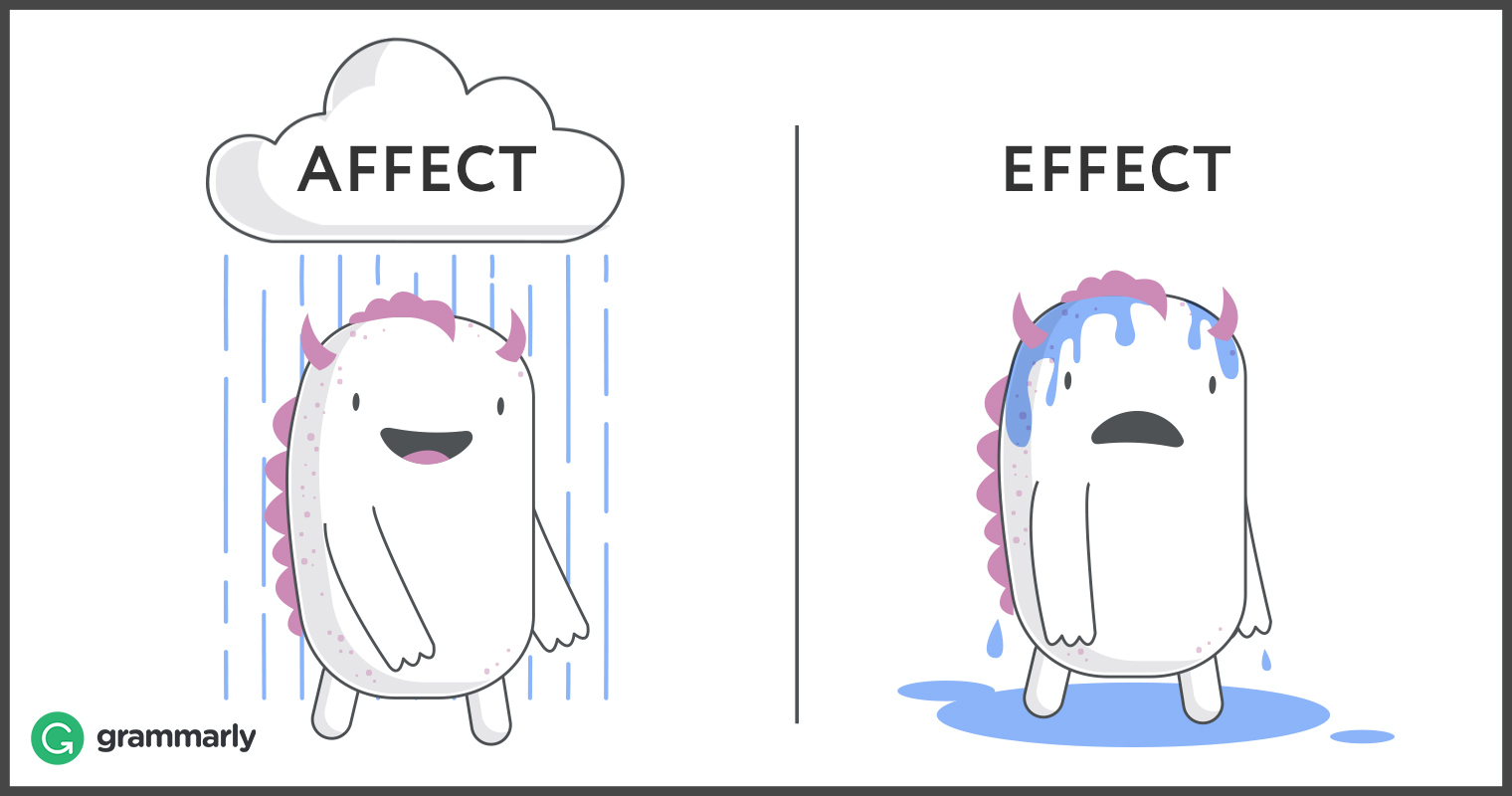
The cutest affect vs effect meme
Now, you all know how much I do NOT recommend Grammarly.com – because it is an American site/app and so many of the “rules” they talk about are wrong for Australian grammar…
But I just loved this meme they made so much I had to share!




 TJ Withers