We continue to have a teaching shortage in Queensland – see the stats below… And I’ve got some big suggestions for how the Queensland Department of Education can encourage and enable people to become teachers.
Specifically, people like me, who already have degrees and decades of work experience. These are career-changers who want to become mature-aged student teachers.
So I’m going to talk about how long postgraduate students need to study at university before they get into Queensland classrooms.
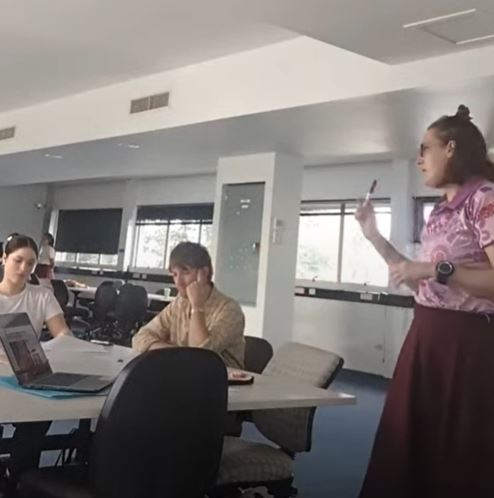
(Teaching a mock lesson at QUT in August 2024.)
For full disclosure, I recently submitted a written piece similar to this as a policy critique for assessment, as part of my Master of Teaching (Secondary). And I got a surprisingly high mark, given that I’m criticising the fundamental structure of the degree!
I’m so proud and happy for all the teachers and educators and staff who are on strike today across Queensland.
It’s their first strike since 2009, and it’s well and truly needed.
Teaching has become a physically and mentally impossible job in this state over the past 50 years, and they deserve everything they’re asking for! (Scroll down to see the needs they’re asking for from the Qld government.)
As a student teacher (called a preservice teacher in Queensland), I was so hopeful going into my first prac this year.
But although the students were DELIGHTFUL, and the school itself was excellent, and I was receiving positive feedback from my incredible supervising teacher, I’m starting to think I may never be a teacher in this state.
I thought finance was bad, with an acronym for every product, project, client, and project management technique under the sun.
This year I’ve been studying the Master of Teaching in Queensland, and I’ve discovered that the education industry is no different.
Leaders ❤ acronyms.
Below is the list of acronyms I’ve compiled in just a few months, but please, help me understand what’s going on here! Tell me what other acronyms I need to know to become a teacher. 😉🙏
I was diagnosed with combined type ADHD about a year and a half ago, so technically, I am one of the many adult learners with a learning disability.
But even before I knew that, making learning about reading and writing accessible was one of my main passions in life.
So while I’ve been doing my Master of Teaching, I have been dyyyyyyying on the inside while trying to read all these academic texts. Almost none are written accessibly!
Academics are out here talking a great game about how we should make education inclusive and accessible to everyone … but when I read their writing, I experience true mental and physical anguish.
If you’re interested, comment your email address and I’ll tell Twinkl to send you a planner. 😎
This post is not sponsored, I just ordered my planner and they gave me a link to send 5 free planners to others. I’ve really been enjoying using some of the Twinkl resources with my kiddo, and using some of them for prepping lesson plans for the younger grades.
One of my favourite resources is this communication slip for learners who are struggling with emotional regulation because they’re either understanding their own emotions, or communicating their emotions safely to others:
This one has quite adorable and intuitive icons for the different emotions (in my opinion) and says, “I feel… because…”
This is a lesson plan I wrote in 2024, to align with the F-10 Australian Curriculum for an English class. I wrote the plan for one of my university assessments, so I’ve put the research receipts down the bottom of the page if you want to look closer into the background information.
I’m just a student teacher studying my Master of Education, so please feel free to provide kind, specific feedback. 😎
How to use this lesson plan: I designed this with multiple parts that you can mix and match if you want to run a single lesson … or you can run all parts over a few classes or a double period.
Duration (mins): 70 minutes per class, designed for 2 class sessions or a double period.
Resources needed:
PPT and projector
Downloaded video clips (for when the WiFi fails us)
Before we get into the lesson plan, though, I just want to clarify one very important question…
Why learn about the patriarchy in English class?
Understanding how the patriarchy perpetuates domestic and family violence (DFV) in Australia is a key part of being an active and informed citizen in 2024. Students are learning empathy as part of the personal and social capability general capability (GC) in the Australian curriculum, and we know that students can build empathy and advocate for others by learning about past and present human rights violations. And because adolescent students are often having their first romantic and sexual experiences, talking about the red flags of abusive relationships helps to protect them from harm.
In a future post, I plan to show you a lesson plan for a Year 10 Psychology class, about how harmful messages in patriarchal societies have affected most people’s implicit biases. Learning to spot our own implicit biases is one of the easiest places to start when learning self-awareness and learning to create psychological safety in our society.
Content for today’s lesson
This lesson focuses on spotting and analysing literary devices and understanding how audiences view a text differently depending on their social and political context. We’ll look at the song Labour by Paris Paloma, which I love as a teaching tool for two reasons.
See YouTube for the official music videos for labour and cacophony (labour) by Paris Paloma
First, many students already know this song because it went viral on Tiktok (and then on the rest of social media). So they’re familiar with some of the lyrics, making more brain space available to do the “thinking” analysis tasks of this lesson.
Secondly, it’s often easier to spot literary devices in poetry texts than in prose like articles or novels, and song lyrics are a highly-effective form of poetry. So teaching Labour as a poetry text means again, students can put more energy towards learning or remembering the content.
If you’re an education student like me, this reasoning provides evidence of you meeting Australian Professional Standards of Teaching (APST) number 2: knowing the content and how to teach it.
We’ve known for a long time that some learners need a certain type of noise or quiet in order to learn.
For example, auditory learners will learn best by listening or by having noise in the background while they’re trying to learn something.
And learners with sensory-avoidant sensitivity often need quiet to learn – like an ADHD or autistic student needing to wear noise-cancelling headphones in a noisy classroom or to get through a school assembly.
But here’s the wild part that I didn’t know, but I learned this week in class!
I noticed this week that I was getting annoyed that one of my teaching textbooks consistently uses “practice” every time, when they actually should be using the verb “practise” in some sentences.
How do you know when to use practice or practise?
To practise is a verb that means you’re doing the same action or process over and over, usually over time, to get better at that action or process. For example…
I’m currently studying my Master of Teaching (Secondary), so I thought I’d start sharing some of the gems I am discovering in the education and training sector!
I’m also working at the same time, in the not-for-profit sector, where training adult volunteers and facilitating group events is a big part of my role. So I’m getting to exercise the things I already know about training and teaching there, as well!
Today’s tip comes from an American study, but next week I’ll bring you an Aussie one… Because you know I think our local context is one of the most important things, whether we’re talking grammar or publishing books or teaching!
How to help students succeed, by teaching them a growth mindset
So in 2016, an American study of 125 math teachers and their 3,965 Grade 9 students, looked at how students felt about their teacher’s attitude about each student’s ability to learn, and how the teacher acted in the classroom…
And compared that to what the teacher said in a survey: Did the teacher believe they had a growth attitude themselves, and did they believe they were passing on that mindset?
Wait, what’s a growth mindset?
A growth mindset is where you believe that you can learn to do anything you need to, so you can achieve anything you need to if you keep trying to learn it. (The opposite is a fixed mindset, where you believe you are either good or bad at doing something, and your ability to learn new skills is limited or “fixed”.)
The example in this study was: “My math teacher believes that everybody in my class can be very good at math.”
How to help students grow a growth mindset
The short version – heavily paraphrased by me – is that, if you want to create a growth mindset in your classroom, to help every student have a better chance to succeed academically:
When a student is struggling, we reassure them that the struggle – the effort it takes to learn something new – is natural, e.g. “It’s definitely confusing when you’re learning a new concept, and it’s totally normal to feel frustrated.” or “Everyone gets stuck sometimes, and we keep trying new things until we get it.”
Share accountability for the student’s success at learning, e.g. “We’ll work together on this, and we’ll make sure you get it.”
Avoid putting it back on the student to just work harder, e.g. “You have to put in the effort and study.” would not be helpful.
And the crazy takeaway from this study is that it doesn’t seem to matter whether you, as a teacher, actually have a growth mindset or not!
Whether teachers reported in the survey stage that they have a growth mindset and they focus on teaching that to their students, or whether they said they have a more fixed mindset, or whether they said they have a growth mindset but they don’t focus on teaching that to students, didn’t affect whether students developed a growth mindset.
So we can hope that as long as you’re helping your students to believe they can learn and believe that you’ll provide help as needed, then they are likely to develop a growth mindset in your subject or class.
This 2016 study was conducted by Hooper, Haimovitz, Wright, Murphy, & Yeager – and I should note that I’m mostly reading analysis by Haimovitz and Dweck, 2017, because it’s a lovely summary.
Are you a teacher?
Send me your best teacher tips! I love learning, and although I’ve been training adults and working with young people for years, I’m so excited to be learning new strategies for helping teens become more confident, more capable, and lifelong learners.
Special thanks to the teachers who shaped my young, creative, undiagnosed-neurodiverse brain in ways that helped me find my growth mindset! Chronologically, Mr Fittell, Mr Pitt, Ms Suarez, Mr Hanlon, Mx Dugan. ♥
A youth group or kids club devotion for ages 5 to 15 on treasure
So tonight was all about pirates and what’s one thing pirates love more than anything else? What do you think?
[discussion]
Those are all great answers, and the one I want to talk about tonight is treasure – pirates love treasure!
Do you have anything in life that you would call your “treasure”? Your most precious things?
[discussion]
God actually talks about treasure in the Bible in a bunch of different places, and the first one I’m going to talk about tonight is Matthew 13, where Jesus says that God’s world, the kingdom of heaven, is like treasure hidden in a field. When a man finds that treasure, he sells everything he owns so that he has enough money to buy the field that contains the treasure – because he knows that treasure is so precious, it’s worth more than everything he owns.
If we think about this story for a second, Jesus is saying that God’s world – a world where people worship God, where people live sustainably and they live in harmony with nature, a world where people actually love each other and don’t hurt each other, a world where everyone has enough to eat – that world is so precious that it’s worth more than everything you own.
God’s world – a world where people worship God, where people live sustainably and they live in harmony with nature, a world where people actually love each other and don’t hurt each other, a world where everyone has enough to eat – that world is worth more than anything you could own
Then in Luke 12, Jesus literally tells his disciples, sell the things you own and give money to the poor. That way, you will earn a treasure in heaven that doesn’t disappear or break, and one that no thief could steal, and no bugs could eat it up. Basically it’s a reminder of what we were talking about a few weeks ago – that everything in life is temporary except for God. So if you make God your treasure, if you love God more than you love new clothes or music or money, and you use the things you have to help other people, not just yourself, then you won’t be disappointed when your “things” don’t last – because God does last.
God will always love you, no matter what else is happening in your life.
Let’s pray. God, please help us to love you more than we love anything else. Help us to have a great week and to help other people to have a great week, too. Amen.



 TJ Withers