Is it really that bad? What the MAFS manchild squad has done on screen
Well, let’s start with Paul.
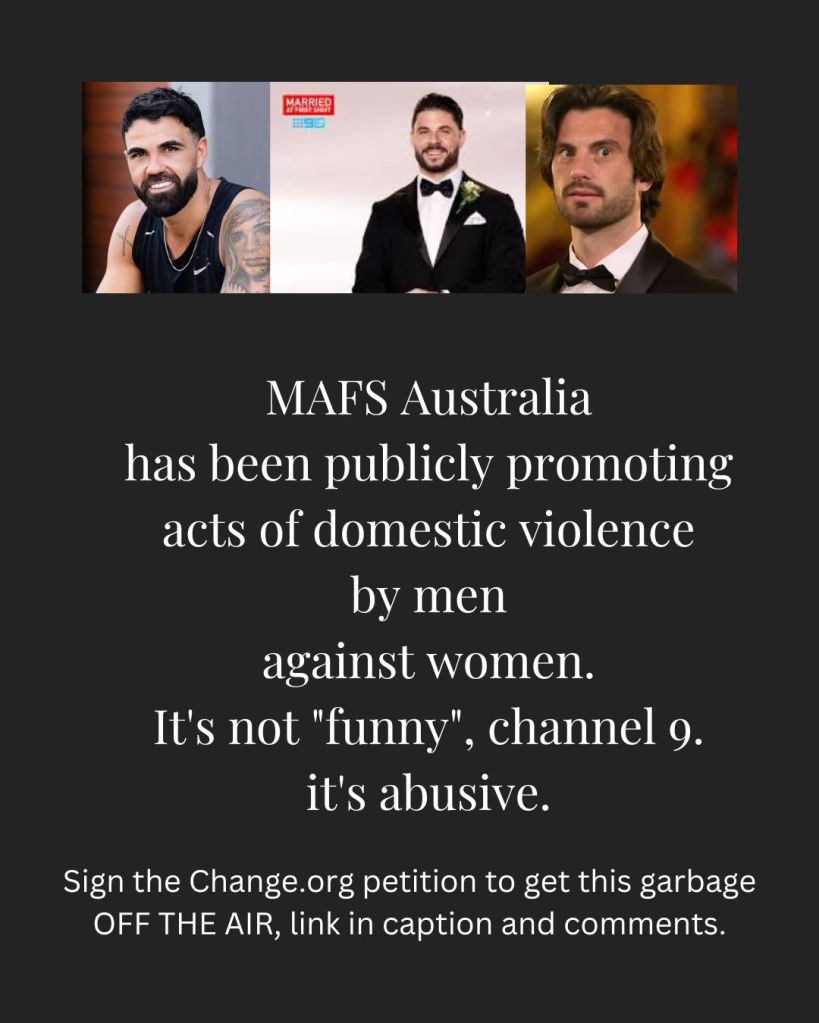
Paul punched a wall when he lost his temper – an act of physical violence that meets the legal definition of domestic violence, and is a high risk factor for assault and murder of an intimate partner.
It’s harder to say “happy new year” when you remember that 101 women were killed by men in 2024 (Femicide Watch Australia, 2024).
It might not sound like a huge number, until you compare it to the 46 women who were killed by men in the 2022-23 financial year (AIHW, 2024).
Men killing 101 women in 12 months is horrific because it is a doubling of violence against women in Australia.
Domestic and family violence is a national emergency, with 1 in 4 Australian women having experienced violence from a male partner (White Ribbon, 2024).
With that in mind, I read the following books last year, and I believe they would help any Australian man who wants to understand the current war on women and children in our nation.
More importantly, this information can help any person who wants to help us end the war on women.
I was thoroughly impressed by the way these writers gathered measurable data and research from all around Australia and sometimes internationally.
I’m sure you’ll find the statistics astounding – because I did, and I’ve already been reading on these topics for 20 years.
A note on gender references: All references in this article to “women” include trans women. Much of the data on “women” also includes non-binary people, who are routinely marked as female “for insurance purposes”.
Always was, always will be, Aboriginal and Torres Strait Islander land, air, and waters.
So I was delighted to see First Nations Senator Lidia Thorpe call out the current King Charles… and disgusted to see mainstream media reporting it as “angry woman attacks 80-year-old man with cancer”.
Senator Thorpe is a Gunnai, Gunditjmara, and Djab Wurrung mother, grandmother, and advocate.
Senator Thorpe had tried earlier that month and that week to arrange a private meeting with King Charles to discuss these matters outside of the public forum, but he had refused.
She waited politely until King Charles had finished his speech before she made her statement to him.
Then Lidia Thorpe delivered her now already-famous speech.
Lidia Thorpe’s speech to King Charles
“You are not my king. You are not sovereign. You committed genocide against our people. Give us our land back. Give us what you stole from us, our bones, our skulls, our babies, our people. You destroyed our land. Give us a treaty. We want a treaty in this country. This is not your land. This is not your land. You are not my king. You are not our king. Fuck the colony.”
This post was originally published in October for Domestic Violence Awareness Month. As you know, in Australia, we have been in a femicide epidemic since 2022.
Every 4 days in Australia in 2024, another woman is murdered by a man.
Usually a man she knows.
Usually, she is a First Nations woman, or a disabled woman, who are both attacked and murdered at much higher rates than others.
Almost always, the attacker is a straight, white male.
This matters. It matters so much.
No one deserves to be brutally murdered, like these women have been. No one.
And especially as you will see below, most of these murders could have been easily prevented by police, courts, and the government.
So we have to condemn men’s violence against women, by talking about them until it changes.
Until the governments believe us, and act on it.
Until the police believe us, and act on it.
Until the courts believe us, and act on it.
Today, I’ll be focussing on the ways the police in every state and territory across Australia has been failing women, children, women of colour, non-binary people, trans people, queer people, etc.
This choice to focus on the police is validated by the fact that so many states’ police forces tried in 2024 to suppress the results of internal and external investigations that showed they were failing DFV victims.
For example, it was uncovered in October 2024 that Queensland Police Service (QPS) had deliberately blocked “damaging” reports about their Service Delivery Program’s dealings with DFV victims. Internal emails about Queensland Police’s failure were confirmed by direct quotes from their own leadership.
Throughout this post, I’ve linked to reports about police failing to catch male killers and failing to protect the women and children whom these killers targeted.
What you need to know about women’s lives and men’s violence while reading this article
I want to honour the lives of the 102 women killed by men in 2024, because they are so much more than just statistics.
Each of them were loved by family and friends.
I have included links to my main sources for this information, including the amazing resources created by journalist Sherele Moody. I have tried to source only articles that included names and photographs after seeking consent from the families of these women; however, the media doesn’t always do this, so I couldn’t always find respectful sources. If you are a First Nations reader, please know that some of the articles I’ve linked to include photographs of the women who were killed.
I have also made my best attempt to uncover the correct gender identity and pronouns for each of these people, and after more than 2 days of research, I have reached the limits of what I can find out online for free. If you find any misgendering errors, please let me know and I will update this article with sincere apologies. I want to stop men’s violence against all humans, whether they are women, children, people of colour, non-binary people, trans people, other men, etc.
Finally, I could not write about men’s violence against women in Australia without acknowledging the atrocities that male political leaders, male soldiers, male police, and other men are committing right now across the world. War, genocide, and other violence against women continues unchecked in Gaza, Lebanon, Sudan, Darfur, the Democratic Republic of Congo, Ukraine, Afghanistan, Syria, and many more countries as I write this.
What can I do to stop domestic violence in Australia?
For those who cannot read about injustice without acting on it – like me – I recommend these actions:
If you’re a man, I want to see you posting about domestic violence issues. I firmly believe all men should be actively working to prevent men’s violence against women and children, and demanding systemic changes from the government so that victim-survivors can leave and stay safe. What about “not all men”? No. Until all men are actively campaigning to stop men’s violence … it is all men.
Donate to your local DV support services, or to the families. Women’s shelters, domestic violence shelters, and DV support services are all ridiculously underfunded by local, state, and federal governments. In 2024 alone, many DV shelters have had to close their doors, including the one that was controversially closed by the Perth Mayor and WA Premier. If you can afford it, give a little – every little bit helps, and it’s tax-deductible. If you prefer to donate directly to the families of these 63+ women, you can find and donate to their GoFundMe campaigns, to help them raise money for funeral or memorial services.
Email your federal and state Members of Parliament (MP). You can find the contact details for Queensland MPs easily, and you can usually find contact details for most federal Senators and MPs. Ask them which women’s shelters and women’s legal services they are directly funding, and demand that they pay more. Tell them to increase staffing at courthouses, so that victim-survivors can get DV protection orders faster. In Queensland, it currently takes up to 2 years to get a protection order that only lasts 5 years. Australia has a budget surplus in 2024 – THE GOVERNMENT CAN AFFORD TO DO BETTER!
Send a complaint to Centrelink, who routinely denies DV victim-survivors the financial help they need: the Crisis Payment for Extreme Circumstances Family and Domestic Violence, and the separate Escaping Violence Payment (EVP) program. Tell Centrelink to hire more people for their DV section and their Families Line. Because DV victim-survivors should be waiting on the phone for hours every day for weeks, just to hear, when they finally reach the top of the queue, “We can’t help you.” It’s not good enough. Australia’s budget surplus means the government – through Services Australia and Centrelink – can afford to help more vulnerable women and children than they do.
Send a complaint to the Police Commissioner in your state or territory about one of the 63+ women who have died this year so far. Ask the commissioner what they are doing today to prevent any other women dying in their state or territory. Because as you will see from the below records, many of these women would still be alive today if police would just do their damn jobs.
If you know a lawyer or have a lawyer, ask them how many pro bono cases they take on. Every lawyer in Australia should be helping at least one domestic violence victim-survivor with trying to get protection orders, parenting orders, Victim Assist payments, home loan contracts, workplace harassment suits, Wills and estates, and more. All of these factors can force victims to stay with violent men or stay in bad situations, unless they have the money to hire a lawyer – which most women do not.
If you’re worried about someone you know, phone your local police station and ask to speak to a sergeant. Ask them to make a “welfare check” and put it on record that you have reported concerns about someone’s violence or concerns for someone’s safety. Our taxpayer dollars are paying these cops’ salaries. It is literally their job to go and check that violent men are staying away from women and children like they should be. As you’ll see in the article below, most of these women’s bodies were only discovered because friends and family told police to go look.
Worried for your own safety? Call 000 in an emergency. Or call the 24/7 DV counselling line 1800 RESPECT. First Nations women can call 13YARN Crisis Supporters 24/7 on 13 92 76, for help that’s designed by mob for mob. And even if the police haven’t been helpful before, report every incident to them on 000 or PoliceLink, and ask them for an incident report number. Queensland Police has a “vulnerable person” SMS service you can register for, so you can text them to make a report.
The incredible Grace Tame recently did an interview on the podcast The Imperfects, and it reminded me all over again that we need to keep talking about this. Thank you, Grace!
It may be 2024, but in Australia, most states and territories still do not allow victim-survivors of sexual assault and domestic violence to speak thetruth.
Vulnerable people are silenced by the very legal system that claims it wants to protect us.
The legal system disproportionately favours the person with more money and power. That usually means abusers, who:
Have often spent years controlling or withholding household finances
Typically earn more thanks to the gender pay gap that still exists in Australia
Have the power of a respected position in the community, or
Are confident that their victim is not legally allowed to speak up about what they did.
With pro bono legal services and DFV support services across the state already stretched beyond capacity, vulnerable women, non-binary people, trans people, and children, are being left to fend entirely for themselves.
The current legal system in Queensland perpetuates abuse. Because it’s easier for an abuser to control a person when they know that person cannot “out” their abuser.
In my research into Australia’s domestic violence epidemic, I’ve found an endless list of cases in Australia where parenting orders have been used as a blunt instrument to punish mums who were trying to keep their children safe from domestic violence and other crimes.
Apologies that the language about the parents in this post is mostly gendered (“mum”, “dad”, etc.). I could have said “parent A / parent B”, but instead, I’ve used gendered language based on how the parents were talked about in the court judgements because I don’t know these people’s preferred pronouns.
So let’s talk about why in Queensland, the Family Court of Australia and the Magistrates Courts, mums get slammed for doing the very thing mums are known for: protecting their babies.
This is not legal advice; I am not a lawyer. I am publishing this as a concerned citizen and an advocate for DFV victim-survivors.
And please ignore any typos; I was typing out this post on my phone this morning when I couldn’t sleep. #3amthoughts am I right? 😅
This original poem by TJ Withers is a response to the national OurWatch ad campaign and the global social media trend. See the hyperlinks within the poem to get all the context.
Men killed fifty-four women and four kiddies in seven months – who’ll be next?
It’s impossible to bear
Tiktok asked if we walked alone in the woods, would we rather see a wild bear, or a man?
Them men chose the man
We women choose the bear, because
If a bear attacks, people believe us
They don’t say, “He’s a good bear, though. He would never.”
If a bear attacks, you can see the scars
We can prove it happened
Hospital reports, doctor’s notes, days off work
If a bear attacks, the worst it can do is kill us
It don’t desire
To overpower
The bear mauls but won’t assault
If the bear attacks, and we tell someone what happened, the bear don’t sue us
The bear ain’t offended
The bear don’t deny their actions
The bear don’t have money and lawyers and an ego
If the bear killed us, people wouldn’t say,
“She should’ve chosen a better bear.”
If the bear attacks, police would say we were brave – not belligerent
But they say,
“She got aggressive”
“She provokes that bear”
“Put her in jail”
“Take her kids away”
No, nobody makes us raise kids with the bear afterwards
When the bear leaves, he’s gone
If the bear attacks, and it chews us up, spits us out,
They think it’s “not all men”, so good men should stop the bad ones
But if it’s not all men, where are the men?
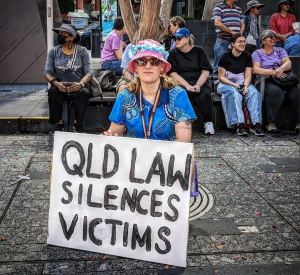
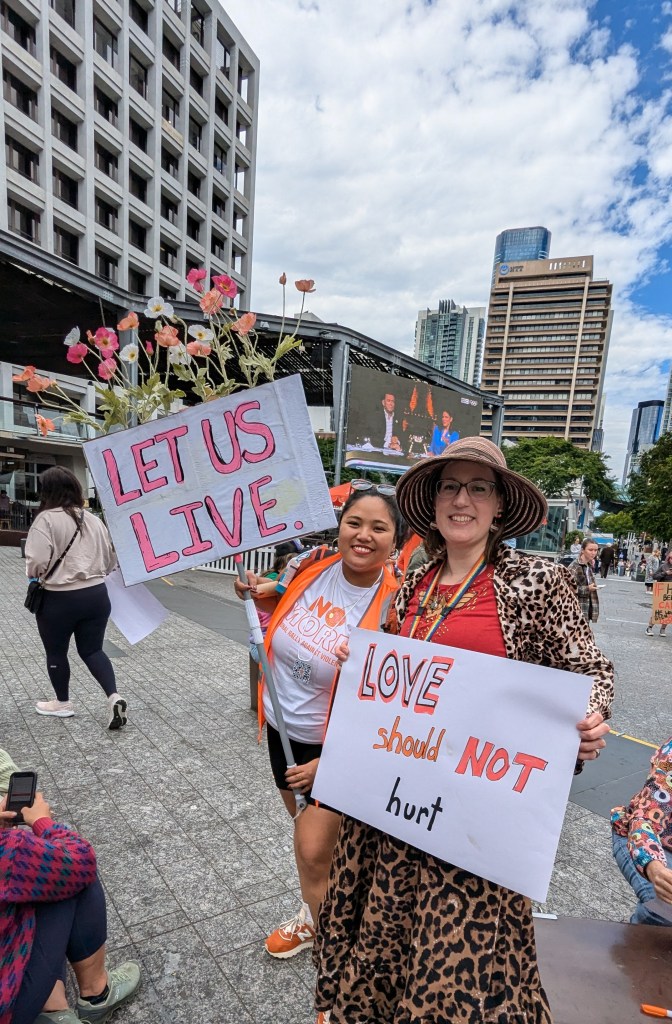
At our July march, I see one
Old, white, brings a camera
Points it in the face of women without asking first
We cringe
He’s right up close
Up close is where it happens
We were worried about the stranger walking behind us, hoodie strings drawn
Clutched our car keys tight
But that’s not where it starts
No, it’s behind closed doors
They kill a woman every four days
They take what they want, then say she wanted it
They say they earn more, so she stayed home with the kids
They say she can’t see them, so she’s suddenly alone
They say they love her, so she tries not to talk about it
Feel bad
Know something’s wrong
But she’s in her own home
Relationships aren’t meant to be this hard, right?
When social media says more than the pollies
Because we’re the ones who care
It’s impossible to bear
That’s why we choose the bear
This is an original poem written by me, TJ Withers, as a reaction to the femicide epidemic of domestic and family violence (DFV) against women in Australia in 2024. All images are my own, taken at Brisbane’s July march in the series of national marches in the No More Violence Rally organised by the amazing humans and women and trans women and non-binary people at WWYW? Australia. This post does not implicate any men in the commission of DFV against the author or any other woman.
I thought finance was bad, with an acronym for every product, project, client, and project management technique under the sun.
This year I’ve been studying the Master of Teaching in Queensland, and I’ve discovered that the education industry is no different.
Leaders ❤ acronyms.
Below is the list of acronyms I’ve compiled in just a few months, but please, help me understand what’s going on here! Tell me what other acronyms I need to know to become a teacher. 😉🙏
I was diagnosed with combined type ADHD about a year and a half ago, so technically, I am one of the many adult learners with a learning disability.
But even before I knew that, making learning about reading and writing accessible was one of my main passions in life.
So while I’ve been doing my Master of Teaching, I have been dyyyyyyying on the inside while trying to read all these academic texts. Almost none are written accessibly!
Academics are out here talking a great game about how we should make education inclusive and accessible to everyone … but when I read their writing, I experience true mental and physical anguish.
If you’re interested, comment your email address and I’ll tell Twinkl to send you a planner. 😎
This post is not sponsored, I just ordered my planner and they gave me a link to send 5 free planners to others. I’ve really been enjoying using some of the Twinkl resources with my kiddo, and using some of them for prepping lesson plans for the younger grades.
One of my favourite resources is this communication slip for learners who are struggling with emotional regulation because they’re either understanding their own emotions, or communicating their emotions safely to others:
This one has quite adorable and intuitive icons for the different emotions (in my opinion) and says, “I feel… because…”




 TJ Withers