Different From vs Different To (Australian)

I had to research this one myself a few years back, because I was always taught “different to” was correct, but I hear people all over the place saying “different than”, “different from”, etc.

So here we go, let’s word nerd out – here’s what the experts say about how you can use the word “different”.
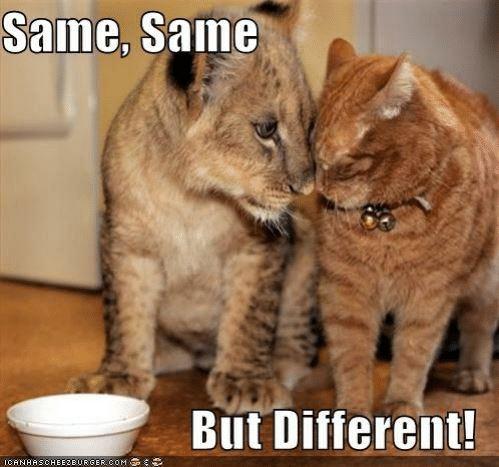
Image source: icanhascheezburger.com

Is it different from, different to, or different than?

If you’re aiming to sound correct to most of the world, both “different to” or “different from” will be good. And “different than” will sound incorrect unless you are speaking specifically to an American audience.

All of the below examples are therefore correct usage according to the modern standard:

e.g. Our app works differently to our competitors’ apps, and that’s why it’s more stable than other apps.

e.g. Our ways of working are different now to what it was like before the COVID-19 pandemic.

e.g. The QSuper Lifetime investment option uses an investment strategy that’s different from our Balanced or Aggressive investment options.

Why different to and different from are both better than different than

When you Google grammar tips, add the word “Australian” or even “Oxford English Dictionary” to your search so you can get tips that are valid for Australia, rather than getting a bunch of American results that don’t apply here.

First, I took a look at what the Australian Writers’ Centre says. They said you can technically use any of three prepositions “to, from, than” with the adjective “different”.

But they did point out that “different from” is most commonly used around the world; “different to” is most common in Australia and the UK; and in the USA they also use “different than”.

For the history, apparently “different to” was the earliest version used, and before the 1700s, you could also say “different against” – but obviously we don’t say that anymore.

The Oxford Learner’s Dictionaries and Collins Dictionary both agree with that approach.

(C) TJ Withers-Ryan, 2022. Please credit me when you repost/share, thanks!

How to know when you’re using active vs passive voice

Lots of us were trying to stay active all pandemic, even though we were stuck at home – but just as importantly, is your writing active or passive?

And why does it matter?

What is active and passive voice?

Active voice means that your voice (the subject of the sentence, usually a noun is at the start, followed by what your subject is doing (the verb), then the object the verb is happening to.

e.g. We (subject) offer (verb) default insurance (object) to eligible members (secondary object).

Passive voice means the object (the thing it’s happening to) is up front. This type of sentence is usually missing its subject (the person doing the thing).

e.g. Default insurance (object) is offered (verb) to eligible members (secondary object).

How do you know if you’re using passive voice?

You can tell if a sentence is missing its subject — and is therefore in passive voice — because you can add “by zombies” to the sentence and it will still make sense.

Image source: Wikipedia

e.g. Default insurance (object) is offered (verb) to eligible members … by zombies.

Why does everyone say you should write in active voice?

Now, here’s why you want to write in active voice whenever possible:

1. Readability. I like it when skimreaders (a.k.a. every busy person ever) can easily understand what I’m writing about. Readers’ brains like simple sentence constructions that are in active voice.

2. Less work for your brain. The active voice construction “subject, verb, object” is the first and most common one taught in English-speaking schools, so it’s harder work for your brain to remove the subject and construct a passive sentence.

3. Reduce risk of RSI. Passive voice sentences are typically much longer, with more words, which means more typing and more repetitive strain.

So save your brain and your wrists from the zombies, and write in active voice.

Common misunderstandings about active voice

One thing I’ve noticed is that sometimes writers, reviewers, and even less-educated editors will talk about “active voice” when they actually mean to talk about one of the 12 tenses in English — “present tense”, “future perfect tense”, etc.

Drives me nuts. Everyone thinks they’re a scholar, but they don’t have the degree or the self-education to give them a real foundation.

The difference between voice and tense is that while the voice changes the whole sentence structure, a tense only changes the verb (the doing word) or the adjective that describes that verb.

(More on how to use the tenses in a later post, if you want to get even more word nerdy.)

So if someone says to you, “This sentence needs to be in active voice.” and you can see that the structure is actually correct — subject, verb, object — then that someone is trying to tell you something about the sentence but it has nothing to do with active or passive voice.

You’ll need to ask that person questions to find out what they actually want to change in your sentence.

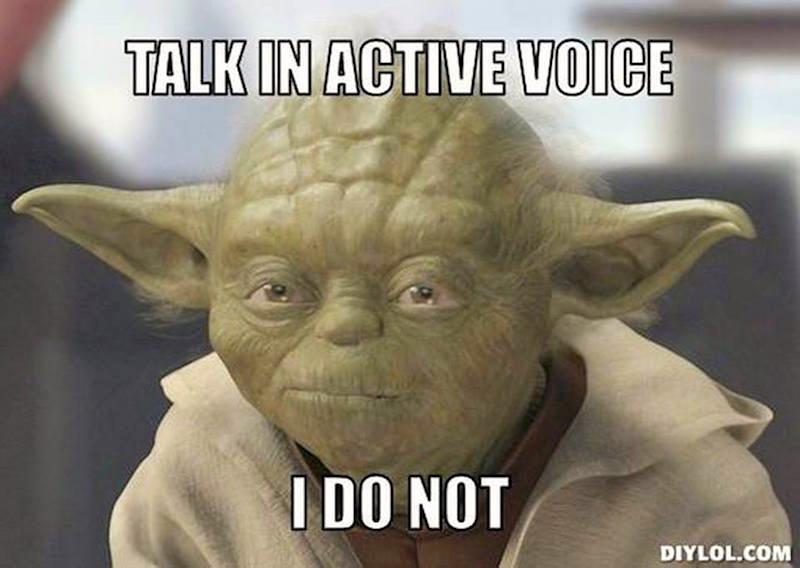
Image source: DIYlol.com by Arnold Zwicky’s Blog

(C) TJ Withers-Ryan, 2022. Please credit me when you share or repost, thanks!

When to use an apostrophe

Today’s tip is how to apostrophate.

Just kidding, that’s not a word.

How to use apostrophes – a few tips.

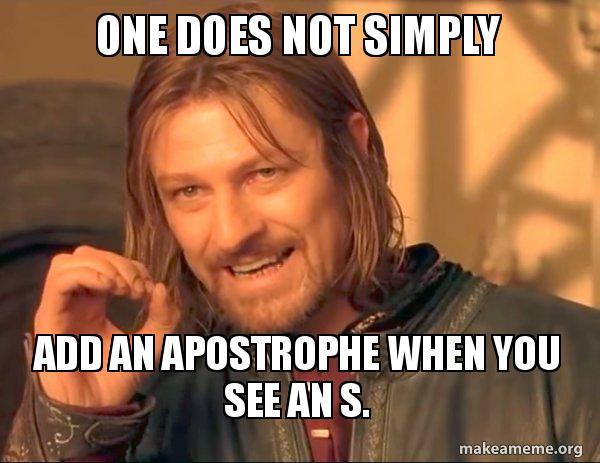
https://media.makeameme.org/created/one-does-not-5bc083.jpg

Image source: makeameme.org

1. Does a person/company/group own something? Use an apostrophe

e.g. We need your driver’s licence as proof of identity.

e.g. We are currently reviewing all customers’ accounts.

e.g. Your team’s efforts should be recognised.

e.g. We won Rainbow Unicorn’s Best Value Award.

e.g. What about James’s report?

Exception: its and your are also words for ownership, but they don’t use apostrophes (compared with it’s and you’re).

You can work out whether you’re writing the exception or whether you need an apostrophe by checking if you can replace the “its” or “your” with a name and apostrophe. If you can, then it’s about ownership.

e.g. The Group has expanded its/your working-from-home capability this year.

>>> This could be replaced with a name and apostrophe, e.g. The Group has expanded Bob’s working-from-home capability this year.

So because the sentence still makes sense after replacing the word, so “its” or “your” would be appropriate.

2. Is it a contraction (two words stuck together and shortened)? Use an apostrophe to glue the words together

Contraction are words that are stuck together and shortened, such as we’ve – a contraction or “we have”.

e.g. At our company, we’ve been looking after members for over 100 years.

It’s = a contraction of “it is”.

So if you can replace “it’s” with “it is”, and the sentence still makes sense, you’re on the right track.

e.g. At our company, it’s all about putting members first.

>>> At our company, it is all about putting members first.

You’re = contraction of “you are”.

e.g. You’re going to need to check your super balance.

3. Is it a plural? No apostrophes

e.g. PDSs, FAQs, MPs, 1980s, he’s in his 50s.

I cringe every time I go to my favourite fish-n-chip shop because the lovely owners’ sign says they have “new special’s every week”. (And yes, we do occasionally chat with them about their sign, but the owners are just too sweet and I always end up hearing all about their grandkids and asking them for advice about my daughter’s toilet training, because y’all know – relationship is more important than grammar.)

4. Is it another type of abbreviation (not a contraction)? No apostrophe

e.g. When we’re referring to legislation, it’s “Cth” not “C’th”.

I think that about covers it (not “cover’s it”), but if you have questions or exceptions you’d like to talk about, please comment!

(C) TJ Withers-Ryan, 2022. Please credit me when you repost, thanks!