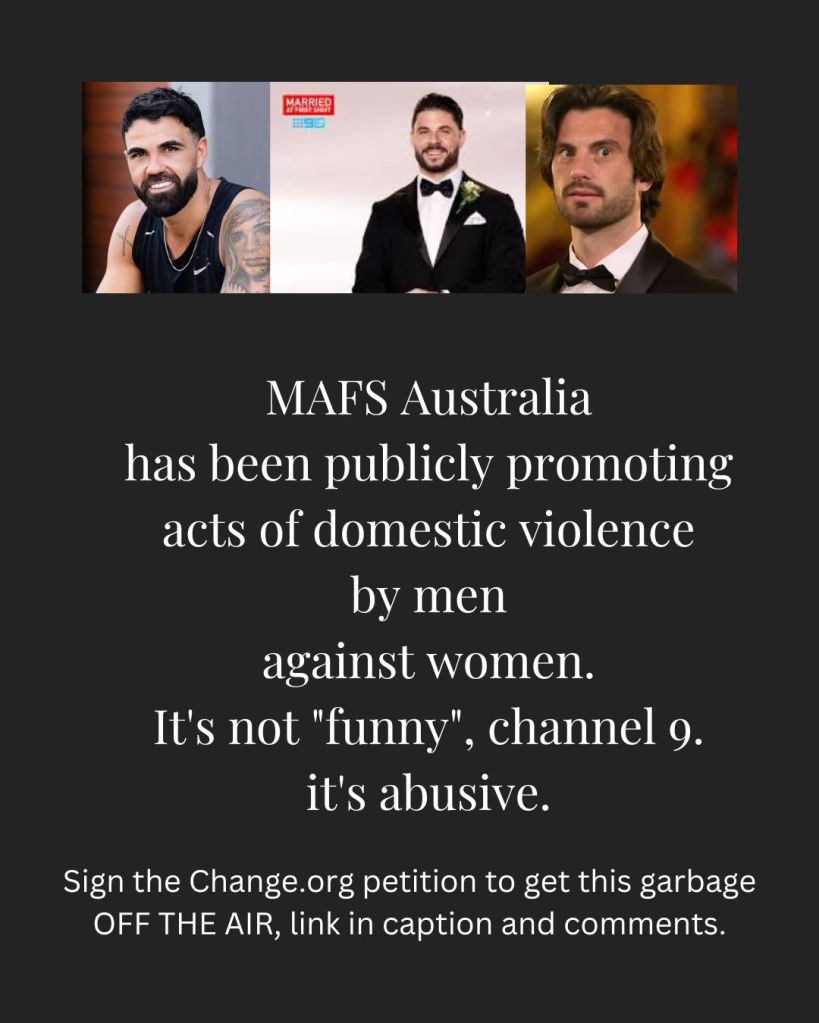
Is it really that bad? What the MAFS manchild squad has done on screen
Well, let’s start with Paul.
Paul punched a wall when he lost his temper – an act of physical violence that meets the legal definition of domestic violence, and is a high risk factor for assault and murder of an intimate partner.
Happy holidays, everyone! I’ve made it through nearly the whole year without ranting about this, which I’m kind of proud of.
I cannot tell you how many books – both traditionally published and indie/self-published books – I’ve seen using the word “smirk” where it doesn’t belong.
A smirk is a one-sided smile. It can be smug, proud, fake, unpleasant, etc.
The easies way to remember the difference between a smirk and a smile is that if a person’s smirking, they’ve either won against the others, or they’re hiding something from the others (could be a good secret or something bad, doesn’t matter).
For example:
‘Merry Christmas,’ said the Grinch with a smirk. Later that night, he planned to press the big, red button in his lair and blow up all the presents.
But if a person’s happy, but not bragging or teasing or hiding a secret, they’re just smiling.
Can’t there be different types of smirk?
Yes, absolutely.
Damon from The Vampire Diaries is the classic example of the many different types of smirk. No one pulls off a smirk like Damon, and he does it in so many different ways or moods.
Here are some of the best examples I could gather for you of his different smirking styles…
Examples of Damon smirking in The Vampire Diaries
Cunning or evil smirk – like in the first few seasons:
You can’t tell what he’s thinking or planning – but the key is that his eyes are not smiling.
Playful or teasing smirk – Damon gives this type of smirk almost every time he interacts with Bonnie – once they become besties, that is.
Arrogant smirk – whenever Damon thinks he’s winning, or he’s managed to fool someone, you see this type of smirk… This screenshot is not the best because he’s talking, but you get the idea:
Loving smile that is sometimes a smirk – you could call Damon’s one-sided smile a smirk sometimes when he’s with the main character, Elena, because he’s hiding a secret from her. (Secret is: he loooooves her. Spoilers for 2011, I guess?)
This is the smile of someone who is proud of themselves for eliciting a reaction from their lover, or proud of their lover.
This versatility in expressions is just one of the many reasons why everyone loved to watch Ian Somerhalder play him in the 2000s and 2010s.
Damon was also a really well-rounded character, but I think I’ve fangirled enough for one post!
Incorrect times to say “smirk”
Sometimes a smile isn’t a smirk – it’s just a smile.
In a lot of novels I see these days, the male love interest is often smirking at the female hero – but not intentionally – he’s actually just smiling.
He’s not teasing her…
He doesn’t have bad intentions to pull one over on her…
He isn’t proudly smirking because he’s elicited a reaction from her…
He’s just smiling – so to say he’s “smirking” feels really jarring and just plain weird.
It makes the reader go, “Wait, what am I missing here? I thought this dude was in love with her?”
Pop quiz: Do you think Damon is smirking or smiling in this picture?
Today is all about how we talk about how many years old something or someone is, or how many years in a row we’ve won an award.
When is it “years old” vs “#-year-old”?
“Years old” is the most common and most reader-friendly way of talking about how old something or someone is (in Australian English).
e.g. CompanyX is more than 100 years old.
You always use hyphens for “#-year-old” because it is either used as an adjective (similar to how you put a hyphen in “award-winning”) … or it is a noun on its own (in which case it is a compound word, two or more words stuck together).
Not using hyphens here is a common mistake.
e.g. Adjective: CompanyX is the largest 100-year-old organisation in Queensland.
e.g. Noun: My 2-year-old is very tall for her age.
When is it “age” vs “aged” vs “years of age”?
Beware of using “age” when you could be using the reader-friendly phrase “years old” instead. I always used to see this often when updating our member-facing forms; it would say “If you are age 55 / 60 / etc.” instead of “If you’re 55 years old”.
e.g. If you are aged 55 years or over, please fill in this part of the form. >>> For readability, it’s easier to say “If you are 55 years old or over”.
e.g. Start planning your retirement before you reach the usual age for stopping work.
e.g. My daughter is only 2 years of age, so she’s not thinking about retirement yet. She is not yet of an age to retire. >>> For readability, it’s easier to say “only 2 years old”.
e.g. This coming-of-age novel is a good read.
Lastly, “year” and “years” can be used in a few different ways.
e.g. CompanyX has won the Platinum rating from SuperRatings for more than 10 years in a row.
e.g. In the year 2020, lots of people began working from home, and it was also my third year working at CompanyX.
e.g. CompanyX has been taking care of clients for more than 100 years.
e.g. Our current investment approach was initiated around 10 years ago, after the GFC.
e.g. You could say someone is wise beyond their years.
Image source: Collegedunia.com
Any other ways of talking about time and age that you’ve seen tripping people up?
(C) TJ Withers-Ryan, 2022. Please credit me when you share or repost. Thanks!







 TJ Withers