Adolescence “uncovers” the misogyny and violence that women have been talking about for decades

I forgot to post this one in March when I drafted it! Everyone, pretend you already saw it in March! 😅
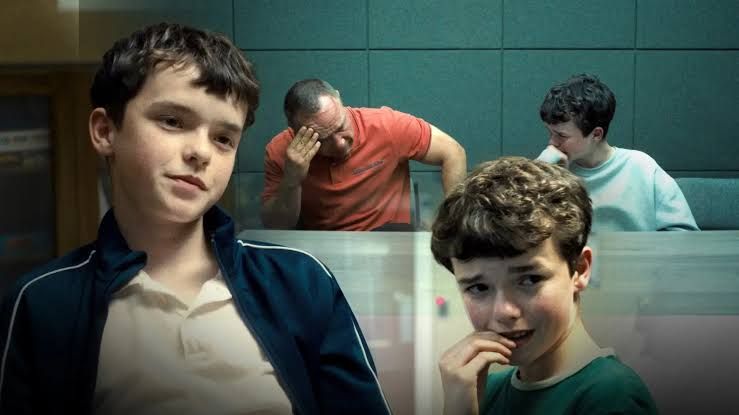
Image source: compilation of stills from Adolescence on Netflix

Netflix’s popular new 4-episode show, Adolescence, is being hailed as a masterpiece in unveiling incel culture in young boys. And I agree, it is a brilliant performance by talented actors, and it is well-filmed, with each hour -long episode being filmed in one shot.

But even the show’s male producer, Stephen Graham, doesn’t seem to understand how his own misogyny creeps into his performance as Jamie’s father on the show.

In an interview with Rolling Stone, Graham claims that his character is just an ordinary Dad, “a hard-working man” who works long hours.

“I didn’t want him to be a violent dad who would raise his hand to his children,” says Graham.

So why do we see this supposedly non-violent male character, being abusive against his wife and children throughout the series, before he violently attacks a young man in public in episode 4?

If this is what the “good guys” think makes a good father… If this is the type of non-violent man who “couldn’t stop” his son from becoming a murder?

Or – more likely – is this series just one more example of a man looking for someone else to blame for men’s violence?

In fact, social media itself isn’t the only scapegoat in this series.

Katie, the girl who was brutally murdered by Jamie, is blamed for her own death.

The detectives and Jamie’s family claimed Katie was “bullying” Jamie, when all she really did was say “no” when he asked her to go out with him, and posting a single emoji – albeit loaded with meaning – on one of Jamie’s posts.

Yes, and this gets cleared up fairly early in the series: In Episode 1, CCTV footage shows Jamie and Katie in an altercation. She pushes him, and he pushes her, and then he stabs her repeatedly.

What’s being said on the internet is not new. This was first all said in grumbling tones by men at the pub, and then shouted at women when those men stumbled home.

Social media isn’t the problem.

Men’s violence is.

Take action against men’s violence today:

  • Sign the petition to the federal government petition to STOP abusers from suing victims who dare to report to police or speak up to warn others.
  • Donate to frontline services who are actively helping women and children leave – and stay out of – violent relationships. I recommend DVConnect for their crisis helpline, RizeUp Australia for providing accommodation and emergency furniture, BRISSC for free counselling and art therapy, and Women’s Health and Equality Qld (WHEQ) for community events and education.
  • Loudly disagree whenever you hear victim-blaming language. (No matter who’s saying it!)
  • Hold boys accountable whenever they hurt girls or women.

Stay safe, friends. xx TJ
Why does it take so long to become a teacher in Queensland?

We continue to have a teaching shortage in Queensland – see the stats below… And I’ve got some big suggestions for how the Queensland Department of Education can encourage and enable people to become teachers.

Specifically, people like me, who already have degrees and decades of work experience. These are career-changers who want to become mature-aged student teachers.

So I’m going to talk about how long postgraduate students need to study at university before they get into Queensland classrooms.

picture of TJ Withers teaching a mock lesson at QUT in August 2024
(Teaching a mock lesson at QUT in August 2024.)

For full disclosure, I recently submitted a written piece similar to this as a policy critique for assessment, as part of my Master of Teaching (Secondary). And I got a surprisingly high mark, given that I’m criticising the fundamental structure of the degree!

Continue reading

We love Queensland teachers and hope their strike wins them the world

I’m so proud and happy for all the teachers and educators and staff who are on strike today across Queensland.

It’s their first strike since 2009, and it’s well and truly needed.

Teaching has become a physically and mentally impossible job in this state over the past 50 years, and they deserve everything they’re asking for! (Scroll down to see the needs they’re asking for from the Qld government.)

As a student teacher (called a preservice teacher in Queensland), I was so hopeful going into my first prac this year.

But although the students were DELIGHTFUL, and the school itself was excellent, and I was receiving positive feedback from my incredible supervising teacher, I’m starting to think I may never be a teacher in this state.

Continue reading

Why so many acronyms? Acronyms in education and teaching I’ve learned so far

Why are there so many acronyms in every industry?

I thought finance was bad, with an acronym for every product, project, client, and project management technique under the sun.

This year I’ve been studying the Master of Teaching in Queensland, and I’ve discovered that the education industry is no different.

Leaders ❤ acronyms.

Below is the list of acronyms I’ve compiled in just a few months, but please, help me understand what’s going on here! Tell me what other acronyms I need to know to become a teacher. 😉🙏

Continue reading

When the guides for inclusive education are not readable for people with a learning disability

I was diagnosed with combined type ADHD about a year and a half ago, so technically, I am one of the many adult learners with a learning disability.

But even before I knew that, making learning about reading and writing accessible was one of my main passions in life.

So while I’ve been doing my Master of Teaching, I have been dyyyyyyying on the inside while trying to read all these academic texts. Almost none are written accessibly!

Academics are out here talking a great game about how we should make education inclusive and accessible to everyone … but when I read their writing, I experience true mental and physical anguish.

Continue reading

Help! It’s too noisy to learn

We’ve known for a long time that some learners need a certain type of noise or quiet in order to learn.

For example, auditory learners will learn best by listening or by having noise in the background while they’re trying to learn something.

And learners with sensory-avoidant sensitivity often need quiet to learn – like an ADHD or autistic student needing to wear noise-cancelling headphones in a noisy classroom or to get through a school assembly.

But here’s the wild part that I didn’t know, but I learned this week in class!

Continue reading