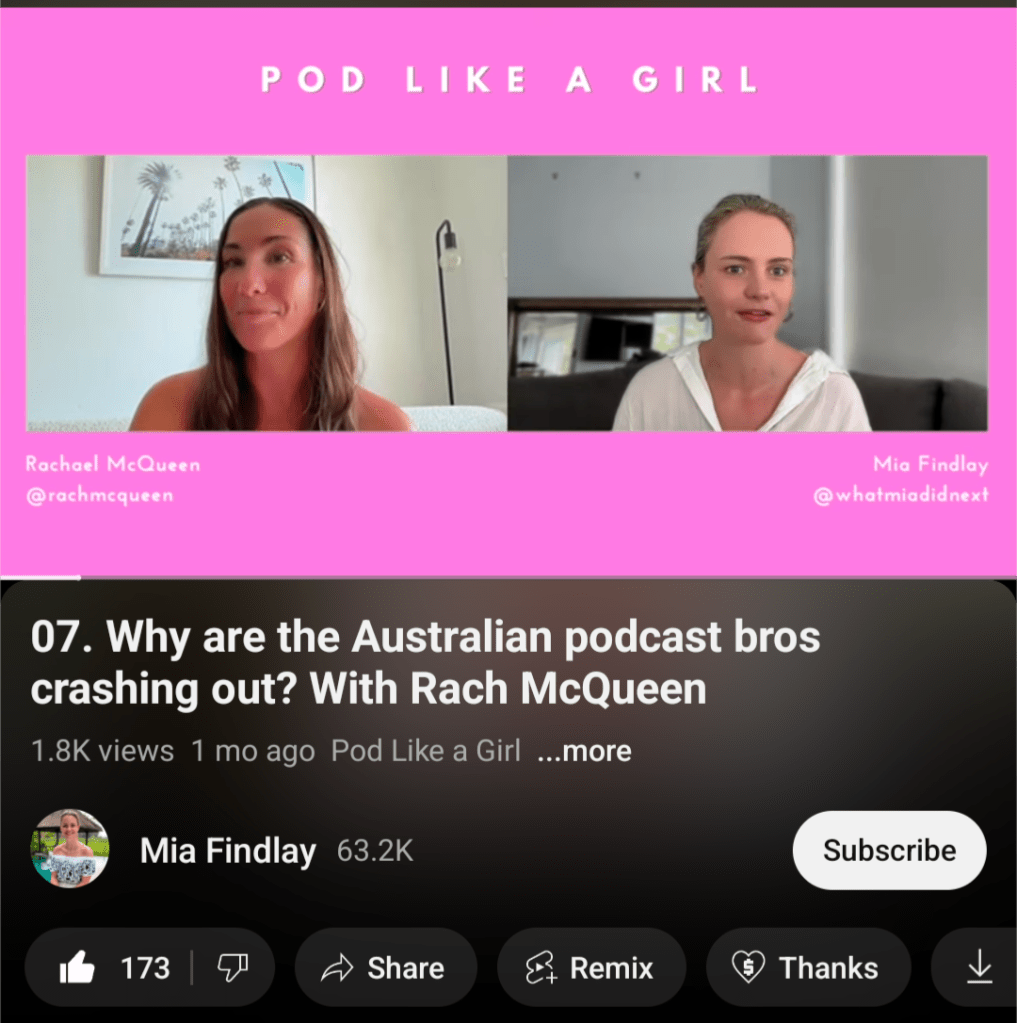
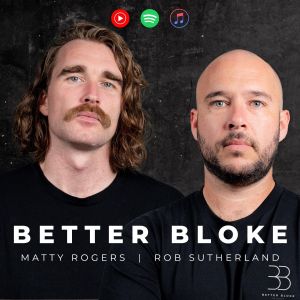
If you’re ready for a hilarious and engaging listen this weekend, start with Pod Like A Girl’s breakdown of the charity fails by “The Better Blokes” podcast.
You can listen to Pod Like A Girl on all the podcast apps, or visit the website to listen to it there:
Or you can watch this important conversation with video on YouTube:
Or you can even download the mp3 file to listen to it another way.
Full disclosure, it’s not just amazing, it’s also enraging, but only because we’re talking about the unashamed misogyny and idiocy of these two man childs.
And Rach and Mia are absolutely the right women for the job, because they’re intelligent and informed.
They’ve also spent years advocating to eliminate misogyny, sexism, and violence from Australia’s culture – and advocating for victims of this misogyny, which we know also harms men themselves.
The men who are going to The Better Blokes project for advice are more likely to be harmed, not helped, by what these blokes are spouting.
It’s the Aussie brand of the Andrew Tate manosphere, where men are encouraged to be a real man, and women are NOT welcome.
Like their videos telling women to “shut the f*** up” and let men speak (direct quote). 🤢 🤮
Which is a problem, because their governing legal documents, their charity charter, says they exist to improve men’s mental health… Not to indoctrinate men with misogyny and encourage violence against women, non-binary people, and even kids.
It’s harder to say “happy new year” when you remember that 101 women were killed by men in 2024 (Femicide Watch Australia, 2024).
It might not sound like a huge number, until you compare it to the 46 women who were killed by men in the 2022-23 financial year (AIHW, 2024).
Men killing 101 women in 12 months is horrific because it is a doubling of violence against women in Australia.
Domestic and family violence is a national emergency, with 1 in 4 Australian women having experienced violence from a male partner (White Ribbon, 2024).
With that in mind, I read the following books last year, and I believe they would help any Australian man who wants to understand the current war on women and children in our nation.
More importantly, this information can help any person who wants to help us end the war on women.
I was thoroughly impressed by the way these writers gathered measurable data and research from all around Australia and sometimes internationally.
I’m sure you’ll find the statistics astounding – because I did, and I’ve already been reading on these topics for 20 years.
A note on gender references: All references in this article to “women” include trans women. Much of the data on “women” also includes non-binary people, who are routinely marked as female “for insurance purposes”.
Always was, always will be, Aboriginal and Torres Strait Islander land, air, and waters.
So I was delighted to see First Nations Senator Lidia Thorpe call out the current King Charles… and disgusted to see mainstream media reporting it as “angry woman attacks 80-year-old man with cancer”.
Senator Thorpe is a Gunnai, Gunditjmara, and Djab Wurrung mother, grandmother, and advocate.
Senator Thorpe had tried earlier that month and that week to arrange a private meeting with King Charles to discuss these matters outside of the public forum, but he had refused.
She waited politely until King Charles had finished his speech before she made her statement to him.
Then Lidia Thorpe delivered her now already-famous speech.
Lidia Thorpe’s speech to King Charles
“You are not my king. You are not sovereign. You committed genocide against our people. Give us our land back. Give us what you stole from us, our bones, our skulls, our babies, our people. You destroyed our land. Give us a treaty. We want a treaty in this country. This is not your land. This is not your land. You are not my king. You are not our king. Fuck the colony.”
This original poem by TJ Withers is a response to the national OurWatch ad campaign and the global social media trend. See the hyperlinks within the poem to get all the context.
Men killed fifty-four women and four kiddies in seven months – who’ll be next?
It’s impossible to bear
Tiktok asked if we walked alone in the woods, would we rather see a wild bear, or a man?
Them men chose the man
We women choose the bear, because
If a bear attacks, people believe us
They don’t say, “He’s a good bear, though. He would never.”
If a bear attacks, you can see the scars
We can prove it happened
Hospital reports, doctor’s notes, days off work
If a bear attacks, the worst it can do is kill us
It don’t desire
To overpower
The bear mauls but won’t assault
If the bear attacks, and we tell someone what happened, the bear don’t sue us
The bear ain’t offended
The bear don’t deny their actions
The bear don’t have money and lawyers and an ego
If the bear killed us, people wouldn’t say,
“She should’ve chosen a better bear.”
If the bear attacks, police would say we were brave – not belligerent
But they say,
“She got aggressive”
“She provokes that bear”
“Put her in jail”
“Take her kids away”
No, nobody makes us raise kids with the bear afterwards
When the bear leaves, he’s gone
If the bear attacks, and it chews us up, spits us out,
They think it’s “not all men”, so good men should stop the bad ones
But if it’s not all men, where are the men?
At our July march, I see one
Old, white, brings a camera
Points it in the face of women without asking first
We cringe
He’s right up close
Up close is where it happens
We were worried about the stranger walking behind us, hoodie strings drawn
Clutched our car keys tight
But that’s not where it starts
No, it’s behind closed doors
They kill a woman every four days
They take what they want, then say she wanted it
They say they earn more, so she stayed home with the kids
They say she can’t see them, so she’s suddenly alone
They say they love her, so she tries not to talk about it
Feel bad
Know something’s wrong
But she’s in her own home
Relationships aren’t meant to be this hard, right?
When social media says more than the pollies
Because we’re the ones who care
It’s impossible to bear
That’s why we choose the bear
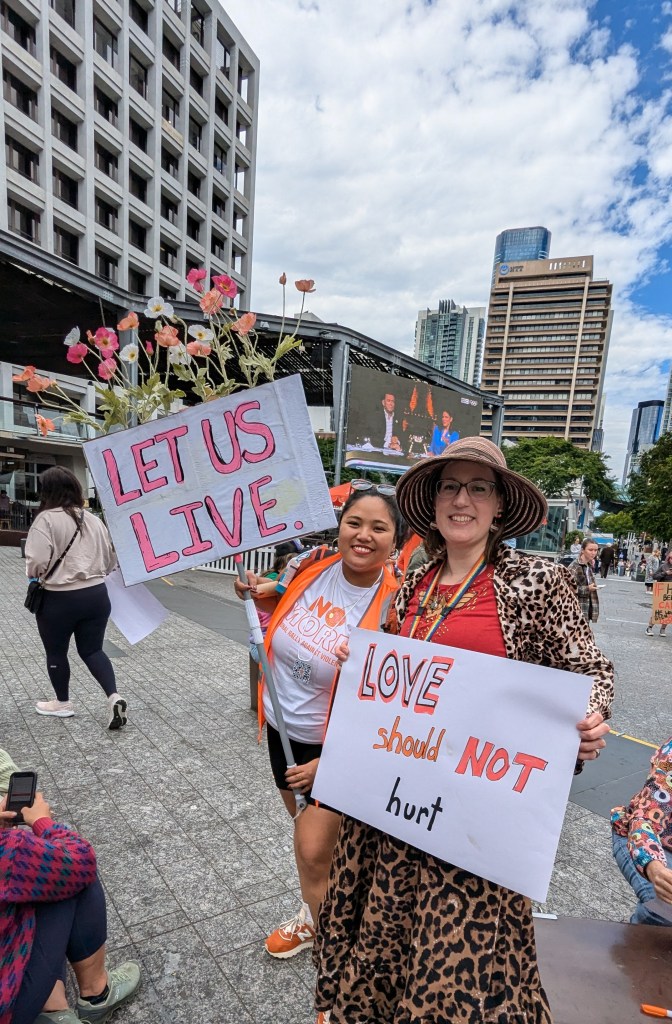
This is an original poem written by me, TJ Withers, as a reaction to the femicide epidemic of domestic and family violence (DFV) against women in Australia in 2024. All images are my own, taken at Brisbane’s July march in the series of national marches in the No More Violence Rally organised by the amazing humans and women and trans women and non-binary people at WWYW? Australia. This post does not implicate any men in the commission of DFV against the author or any other woman.
How to edit truly bad stories Image source: Fonts and Fiction Blogspot
This post is a long one, sorry, but stick with it! I really believe this is something we need to make time for.
Recently, I was looking for inspiration for a part of my novel where one character interrupts a battle to give a passionate speech that marks the beginning of the road to peace. One of the first results when you Google “speech about peace and war” is Martin Luther King Jr.’s little-remembered 1967 speech opposing American involvement in the Vietnam War, ‘A Time to Break Silence’.
I had no idea that reading this speech would change the topic that I would blog on today.
“A time comes when silence is betrayal. In Vietnam, that time has come for us.” – Martin Luther King Jr., ‘A Time to Break Silence’, 1967
Many of you, upon reading the title of this post, assumed that I’m talking simply about my profession of editing. “I say there are bad stories being written out there, and we gonna git ‘em fixed!”
I wish I was.
In the world today, as there has been every year since the dawn of man, there are bad stories being written. By governments and individuals. By my government in Australia. By individuals who I know who think that the government is doing the right thing.
And I need to talk about it. I need to tell you about it. I need to talk about why we are writing a “bad” story and how we can edit it so that we aren’t ashamed of what we have written.
“I cannot say with certainty which of my motives are the strongest, but I know which of them deserve to be followed. And looking back through my work, I see that it is invariably where I lacked a political purpose that I wrote lifeless books and was betrayed into purple passages, sentences without meaning, decorative adjectives and humbug generally.” – George Orwell, ‘Why I Write’ Essay



 TJ Withers