It’s harder to say “happy new year” when you remember that 101 women were killed by men in 2024 (Femicide Watch Australia, 2024).
It might not sound like a huge number, until you compare it to the 46 women who were killed by men in the 2022-23 financial year (AIHW, 2024).
Men killing 101 women in 12 months is horrific because it is a doubling of violence against women in Australia.
Domestic and family violence is a national emergency, with 1 in 4 Australian women having experienced violence from a male partner (White Ribbon, 2024).
With that in mind, I read the following books last year, and I believe they would help any Australian man who wants to understand the current war on women and children in our nation.
More importantly, this information can help any person who wants to help us end the war on women.
I was thoroughly impressed by the way these writers gathered measurable data and research from all around Australia and sometimes internationally.
I’m sure you’ll find the statistics astounding – because I did, and I’ve already been reading on these topics for 20 years.
A note on gender references: All references in this article to “women” include trans women. Much of the data on “women” also includes non-binary people, who are routinely marked as female “for insurance purposes”.
Always was, always will be, Aboriginal and Torres Strait Islander land, air, and waters.
So I was delighted to see First Nations Senator Lidia Thorpe call out the current King Charles… and disgusted to see mainstream media reporting it as “angry woman attacks 80-year-old man with cancer”.
Senator Thorpe is a Gunnai, Gunditjmara, and Djab Wurrung mother, grandmother, and advocate.
Senator Thorpe had tried earlier that month and that week to arrange a private meeting with King Charles to discuss these matters outside of the public forum, but he had refused.
She waited politely until King Charles had finished his speech before she made her statement to him.
Then Lidia Thorpe delivered her now already-famous speech.
Lidia Thorpe’s speech to King Charles
“You are not my king. You are not sovereign. You committed genocide against our people. Give us our land back. Give us what you stole from us, our bones, our skulls, our babies, our people. You destroyed our land. Give us a treaty. We want a treaty in this country. This is not your land. This is not your land. You are not my king. You are not our king. Fuck the colony.”
This original poem by TJ Withers is a response to the national OurWatch ad campaign and the global social media trend. See the hyperlinks within the poem to get all the context.
Men killed fifty-four women and four kiddies in seven months – who’ll be next?
It’s impossible to bear
Tiktok asked if we walked alone in the woods, would we rather see a wild bear, or a man?
Them men chose the man
We women choose the bear, because
If a bear attacks, people believe us
They don’t say, “He’s a good bear, though. He would never.”
If a bear attacks, you can see the scars
We can prove it happened
Hospital reports, doctor’s notes, days off work
If a bear attacks, the worst it can do is kill us
It don’t desire
To overpower
The bear mauls but won’t assault
If the bear attacks, and we tell someone what happened, the bear don’t sue us
The bear ain’t offended
The bear don’t deny their actions
The bear don’t have money and lawyers and an ego
If the bear killed us, people wouldn’t say,
“She should’ve chosen a better bear.”
If the bear attacks, police would say we were brave – not belligerent
But they say,
“She got aggressive”
“She provokes that bear”
“Put her in jail”
“Take her kids away”
No, nobody makes us raise kids with the bear afterwards
When the bear leaves, he’s gone
If the bear attacks, and it chews us up, spits us out,
They think it’s “not all men”, so good men should stop the bad ones
But if it’s not all men, where are the men?
At our July march, I see one
Old, white, brings a camera
Points it in the face of women without asking first
We cringe
He’s right up close
Up close is where it happens
We were worried about the stranger walking behind us, hoodie strings drawn
Clutched our car keys tight
But that’s not where it starts
No, it’s behind closed doors
They kill a woman every four days
They take what they want, then say she wanted it
They say they earn more, so she stayed home with the kids
They say she can’t see them, so she’s suddenly alone
They say they love her, so she tries not to talk about it
Feel bad
Know something’s wrong
But she’s in her own home
Relationships aren’t meant to be this hard, right?
When social media says more than the pollies
Because we’re the ones who care
It’s impossible to bear
That’s why we choose the bear
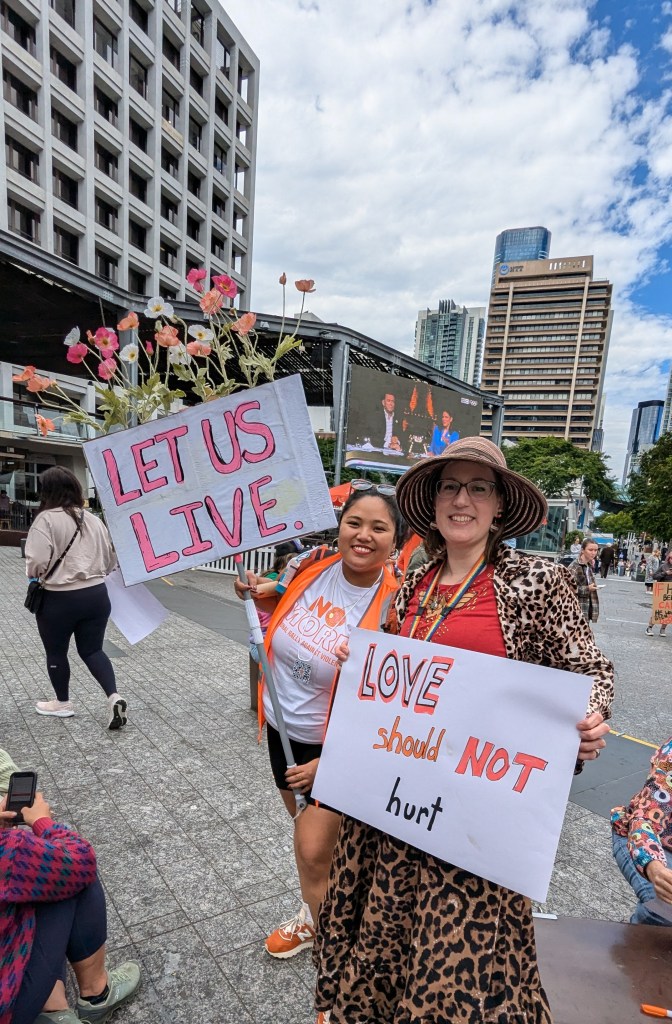
This is an original poem written by me, TJ Withers, as a reaction to the femicide epidemic of domestic and family violence (DFV) against women in Australia in 2024. All images are my own, taken at Brisbane’s July march in the series of national marches in the No More Violence Rally organised by the amazing humans and women and trans women and non-binary people at WWYW? Australia. This post does not implicate any men in the commission of DFV against the author or any other woman.
I thought finance was bad, with an acronym for every product, project, client, and project management technique under the sun.
This year I’ve been studying the Master of Teaching in Queensland, and I’ve discovered that the education industry is no different.
Leaders ❤ acronyms.
Below is the list of acronyms I’ve compiled in just a few months, but please, help me understand what’s going on here! Tell me what other acronyms I need to know to become a teacher. 😉🙏
I was diagnosed with combined type ADHD about a year and a half ago, so technically, I am one of the many adult learners with a learning disability.
But even before I knew that, making learning about reading and writing accessible was one of my main passions in life.
So while I’ve been doing my Master of Teaching, I have been dyyyyyyying on the inside while trying to read all these academic texts. Almost none are written accessibly!
Academics are out here talking a great game about how we should make education inclusive and accessible to everyone … but when I read their writing, I experience true mental and physical anguish.
This is a lesson plan I wrote in 2024, to align with the F-10 Australian Curriculum for an English class. I wrote the plan for one of my university assessments, so I’ve put the research receipts down the bottom of the page if you want to look closer into the background information.
I’m just a student teacher studying my Master of Education, so please feel free to provide kind, specific feedback. 😎
How to use this lesson plan: I designed this with multiple parts that you can mix and match if you want to run a single lesson … or you can run all parts over a few classes or a double period.
Duration (mins): 70 minutes per class, designed for 2 class sessions or a double period.
Resources needed:
PPT and projector
Downloaded video clips (for when the WiFi fails us)
Before we get into the lesson plan, though, I just want to clarify one very important question…
Why learn about the patriarchy in English class?
Understanding how the patriarchy perpetuates domestic and family violence (DFV) in Australia is a key part of being an active and informed citizen in 2024. Students are learning empathy as part of the personal and social capability general capability (GC) in the Australian curriculum, and we know that students can build empathy and advocate for others by learning about past and present human rights violations. And because adolescent students are often having their first romantic and sexual experiences, talking about the red flags of abusive relationships helps to protect them from harm.
In a future post, I plan to show you a lesson plan for a Year 10 Psychology class, about how harmful messages in patriarchal societies have affected most people’s implicit biases. Learning to spot our own implicit biases is one of the easiest places to start when learning self-awareness and learning to create psychological safety in our society.
Content for today’s lesson
This lesson focuses on spotting and analysing literary devices and understanding how audiences view a text differently depending on their social and political context. We’ll look at the song Labour by Paris Paloma, which I love as a teaching tool for two reasons.
See YouTube for the official music videos for labour and cacophony (labour) by Paris Paloma
First, many students already know this song because it went viral on Tiktok (and then on the rest of social media). So they’re familiar with some of the lyrics, making more brain space available to do the “thinking” analysis tasks of this lesson.
Secondly, it’s often easier to spot literary devices in poetry texts than in prose like articles or novels, and song lyrics are a highly-effective form of poetry. So teaching Labour as a poetry text means again, students can put more energy towards learning or remembering the content.
If you’re an education student like me, this reasoning provides evidence of you meeting Australian Professional Standards of Teaching (APST) number 2: knowing the content and how to teach it.
Bluey is the second-most streamed TV show in the world, according to The Guardian. Not the second-most popular children’s show – the second-most popular show, full stop.
Everyone loves Bluey and her family. And I do, too!
But should we? Are Ludo Studio taking their responsibility as a global influence seriously?
After watching the special, 28-minute episode of Bluey, The Sign, some parents aren’t so sure. And this controversial episode has raised some interesting questions about the patriarchal implications in the rest of the series, too.
I noticed this week that I was getting annoyed that one of my teaching textbooks consistently uses “practice” every time, when they actually should be using the verb “practise” in some sentences.
How do you know when to use practice or practise?
To practise is a verb that means you’re doing the same action or process over and over, usually over time, to get better at that action or process. For example…
Happy holidays, everyone! I’ve made it through nearly the whole year without ranting about this, which I’m kind of proud of.
I cannot tell you how many books – both traditionally published and indie/self-published books – I’ve seen using the word “smirk” where it doesn’t belong.
A smirk is a one-sided smile. It can be smug, proud, fake, unpleasant, etc.
The easies way to remember the difference between a smirk and a smile is that if a person’s smirking, they’ve either won against the others, or they’re hiding something from the others (could be a good secret or something bad, doesn’t matter).
For example:
‘Merry Christmas,’ said the Grinch with a smirk. Later that night, he planned to press the big, red button in his lair and blow up all the presents.
But if a person’s happy, but not bragging or teasing or hiding a secret, they’re just smiling.
Can’t there be different types of smirk?
Yes, absolutely.
Damon from The Vampire Diaries is the classic example of the many different types of smirk. No one pulls off a smirk like Damon, and he does it in so many different ways or moods.
Here are some of the best examples I could gather for you of his different smirking styles…
Examples of Damon smirking in The Vampire Diaries
Cunning or evil smirk – like in the first few seasons:
You can’t tell what he’s thinking or planning – but the key is that his eyes are not smiling.
Playful or teasing smirk – Damon gives this type of smirk almost every time he interacts with Bonnie – once they become besties, that is.
Arrogant smirk – whenever Damon thinks he’s winning, or he’s managed to fool someone, you see this type of smirk… This screenshot is not the best because he’s talking, but you get the idea:
Loving smile that is sometimes a smirk – you could call Damon’s one-sided smile a smirk sometimes when he’s with the main character, Elena, because he’s hiding a secret from her. (Secret is: he loooooves her. Spoilers for 2011, I guess?)
This is the smile of someone who is proud of themselves for eliciting a reaction from their lover, or proud of their lover.
This versatility in expressions is just one of the many reasons why everyone loved to watch Ian Somerhalder play him in the 2000s and 2010s.
Damon was also a really well-rounded character, but I think I’ve fangirled enough for one post!
Incorrect times to say “smirk”
Sometimes a smile isn’t a smirk – it’s just a smile.
In a lot of novels I see these days, the male love interest is often smirking at the female hero – but not intentionally – he’s actually just smiling.
He’s not teasing her…
He doesn’t have bad intentions to pull one over on her…
He isn’t proudly smirking because he’s elicited a reaction from her…
He’s just smiling – so to say he’s “smirking” feels really jarring and just plain weird.
It makes the reader go, “Wait, what am I missing here? I thought this dude was in love with her?”
Pop quiz: Do you think Damon is smirking or smiling in this picture?
It’s almost time to say happy new year and good riddance to 2023, so here’s how to write about dates and years in 2024.
This is based on the Australian government’s style manual and the most common usage that I’ve seen over the past few years as an editor of digital content.
The longest day of the year is fast approaching… or on the other side of the world, their shortest day of the world! So I thought we’d talk about how to write dates and days correctly in business writing.
(Image source: AI artwork of cats sitting next to window, watching fireworks, generated using Gencraft.com.)











 TJ Withers