The Power of Procrastination

'Procrastination cat will do it tomorrow' from Lolcat Research

‘Procrastination cat will do it tomorrow’ from Lolcat Research


Today we talk about the power of procrastination!  But wait – how could procrastination possibly be a good thing?  I’m so glad you asked!


All you ever hear is that procrastination means putting off important (but difficult) things and doing unimportant (but more fun) things instead.  Ecclesiastes says procrastination is for the idle: “If you wait until the wind and weather are just right, you will never plant anything, and never harvest anything.”


And that’s definitely true.  But procrastination – if applied in a useful way – is not all bad.  In fact, Dave Windass (of the TED talk “The Power of Procrastination” http://tedxtalks.ted.com/video/TEDxHull-Dave-Windass-The-Power) argues that procrastination is actually the key to being MORE productive, if used *in the right dosage*.

Continue reading

Working Creatively Under Pressure

Coming to hang out at GenreCon 2013 on Saturday 18th? Shoot me an email (see my Contact Us section)!

Today is all about being creative under pressure. In the workplace, whether you are a person doing creative work in a non-creative industry, or a person doing creative work in a creative industry, we all work to various deadlines, and you need to know how to harness your creative process in a hurry!

The best example of successfully doing creative work under pressure is fairly ancient. The story of ‘One thousand and one nights’, also known as ‘Arabian nights’, is the story of Scheherezade in Arabia.

Princess Dunyazade

A portrait of Princess Dunyazade (‘The Coffee Bearer’) by John Frederick Lewis

When a Persian king, Shahryar, discovers that his wife has been unfaithful to him, he has her executed. He keeps on marrying a bunch of women, but each time, he executes her the morning after their wedding, before she has a chance to be unfaithful to him. It is the vizier’s job to provide these virgins to marry the king, but one day he finds they’ve run out! So his daughter, Scheherezade, convinces her father to let her be the next bride.

On the night of Scheherezade’s marriage to the king, she begins telling the king a tale, but she doesn’t give him the ending. He’s so curious to know how the story ends that he doesn’t execute her the next morning. He figures he’ll just wait until he’s heard the ending, then execute her the next morning. But that night, Scheherezade finishes that story and starts right into a new one. But she doesn’t finish it! So the king is forced to keep her alive for one thousand and one nights.

Continue reading

How to put incubation to good use – lessons from the masters

Coming to hang out at GenreCon 2013 on Saturday 18th? Shoot me an email (see my Contact Us page)!


Today is the continuation of the incubation theory, and how to use it: “How can we use incubation to get past writer’s block, without wasting time?” Examples of famous people who’ve put incubation to good use in their creative process.

If you’ve missed my past posts on incubation theory, and you’re wondering what I’m talking about, here’s the recap…

Young Businessman Thinking and Wondering While Writing a Paper Image Source: Writing and PR Studio (BigStock Images)

Young Businessman Thinking and Wondering While Writing a Paper
Image Source: Writing and PR Studio (BigStock Images)

Continue reading

Incubation part 3: Why we (should) sleep on it

Why should we sleep on it? This post discusses incubation, sleep, and dream theory! My own experience, words from a sleep psychologist, and a wacky experiment examining the creative process.

"sleep and dreams and creativity" by Rachel Olsen: http://rachelolsen.blogspot.com.au/2012/10/dreaming-and-creativity.html

“sleep and dreams and creativity” by Rachel Olsen: http://rachelolsen.blogspot.com.au/2012/10/dreaming-and-creativity.html

My own experience:

So you remember how I was working on a novel and I just couldn’t finish it? Right, right, that was months ago. Well, I finally had a breakthrough!

I originally envisioned this novel in three parts, but currently only two parts of it work well. So I was thinking that parts one and two combined work as a standalone novel, with some revision.

But the problem that was to be solved was, at the end of part two, the heroine and her lover part on opposite sides of an intergalactic war. As enemies. So sad! And since I’m the kind of person who doesn’t deal well with sad endings (open that box of worms another day), this ending had to be fixed!

Continue reading

What does an editor do?

View my rates for editing, copywriting, or proofreading, on my Freelance Services page!

View my rates for editing, copywriting, or proofreading, on my Freelance Services page!

People often ask me what the difference between proofreading and editing is, or why editing is not just called rewriting.

Some of my pointers here are drawn from what IPEd (the Institute of Professional Editors Limited, Australia’s national editing association) says to authors about how to tell your editor what you need, but most of it is drawn from this year’s experience running my own freelance business as an editor / proofreader (TJ Withers-Ryan).

Step 1: There are three types of “editing”:

1. Proofreading – spelling, grammar, and punctuation. Have you any words out? Are there any typos like eextra letters? Fixing formatting errors like weird italicisation.

2. Copy editing – the line-by-line level, rewriting bad sentences. Does each sentence make sense? Does the author have any *annoying* mannerisms, technical jargon, or other bumps in the road that is their writing? Includes cross-checking facts and figures mentioned. This takes longer but is still pretty straightforward.

3. Structural editing – the story as a whole. Does each chapter have a point to it? Are the characters acting in a way that is consistent with the plot and their own motivations? This takes ages.

So, first, you need to tell your editor what type of editing you need them to do.

Continue reading

Never hold back – Daniel – “Even if…”

When is faith in action ever easy?  But the Bible has some incredible stories about faith in action being rewarded by God!

In Daniel 3:16 – 18, Daniel’s mates (Shadrach, Meshach, and Abednego, aka Hananiah, Mishael and Azariah) are about to get thrown in the fire, and they give one of the best speeches I’ve ever heard:

“The three of them replied to the king, “King Nebuchadnezzar, we do not need to defend ourselves before you about this anymore.  If we get chucked into the blazing furnace that you’ve made, the God we serve is able to deliver us from it.  He will save us from Your Majesty’s power.   But we want you to know this: Even if we knew that our God wouldn’t save us, we still wouldn’t serve your gods and worship them instead.

Woah!

Even if God won’t save me, I’ll still call him my number one God?  I’ll still trust and worship him?

It’s crazy stuff.

It’s awesome stuff.

And God did save them – even more awesome! He provided an angel who stood with them in the fire so that they wouldn’t be burned up. By contrast, the soldiers who had to throw them into the furnace were all burned up immediately by the incredible heat.

Four in the fire from Keith Nicolas WordPress blog

Four in the fire from Keith Nicolas WordPress blog

There have been several moments in my life where God has said, “Even if *this bad thing happens* or *this good thing never happens*, will you still follow me?  Will you still worship me?” and I’ve said yes!  And I’ve known some great friends who’ve had the absolute worst happen and still love and trust God with everything they have.

But today isn’t about me or them or the past – although we’d happily give you details of what God’s done in our lives any time.  It’s about right now, your present situation.

Where is God asking you to let go of control of your life?

Where can you see God asking, “Even if the worst should happen, will you still trust me?”


This post was written by TJ Withers-Ryan © 2013. Reblogging is highly encouraged as long as you credit me as the author.

The Withers Survey: Studying the presence or use of incubation in the creative process

Everyone has their reasons...

“Why are you creative?” from KKB101 lecture, 2011, QUT

Last year I conducted a survey on creativity, mainly among friends and family, but also with some random people I found in the uni computer labs.  I asked everyone I knew, “Are you creative?  Would you like to talk about that?” and many people said yes.  Consider this thanks and an acknowledgement of those who spent time and effort doing my survey.

As a brief introduction, the Withers Survey studied the presence of or use of an incubation period in the creative process.  The traditional theory of a universal creative process is Wallas’s four-stage creative process (1945), which I have discussed in an earlier post on the topic of incubation.  The four-stage process identifies four stages common to most creative disciplines (Davis, 2004, 121-124; CreativeIntensive, 2007):

  1. Preparation in exploring and clarifying a field or concept;
  2. Incubation, a fringe consciousness or unconscious activity related to the idea;
  3. Illumination or the moment of discovery; and
  4. Verification of the result.

My hypothesis was that most people who consider themselves ‘creative’, or have been labelled ‘creative’ by others, engage in some form of incubation as part of their creative process.  This post will discuss the preliminary results and the survey itself.

Continue reading

The last leg of the race

The victorious woman crosses the finish line - Eshet Chayil!

The victorious woman crosses the finish line – Eshet Chayil!

Ever struggled to finish a project?  Yeah, me neither…

I’ve been thinking lately about how crazy busy this year has been, and how I haven’t finished the novel I was working on, although the beginning and the middle are definitely somewhat there…

The point of my post today is that often the hardest part of trying to get somewhere / waiting to achieve something is that last leg of the race.  The week before your loved ones return home.  The last year of uni.  The last month of work before you resign from your old job and start your new one.

Our writing projects often get abandoned right at the end.  I’ve written 42 / 50 chapters for a book that I told everyone I was going to finish in 2011 – now that’s awkward!  And the reason why is that I know how to start with a bang, and the middle is the crux of the story, so that’s pretty set in my mind, but wrapping it all up just looks too big.  I don’t know how to reach those last things that are needed for each of my characters to say, “My part in this story is done, and I’m happy with where I’ve ended up.”  For some characters, I don’t even know what is needed to finish their part.

Jeff Manion spoke at the 2010 Willow Creek Global Leadership Summit about his book, ‘The Land Between: Finding God in difficult transitions’.  He said that the point at which leaders’ plans fail, and people stop volunteering to help, and churches dissolve, is not when you expect.

It’s not at the beginning, because even though looking at a blank slate is scary, most people will be able to imagine the vision that you are setting forth as leader, and it’s exciting to look forward to a future full of hope and promises.  People are happy to give time and money and effort to help a new project get off the ground.  And even in the middle, it’s easy to stay committed, because you can see progress in the steps along the way.

But in that last leg, it’s often hard to see whether or not it is the last leg.  If it looks just like the middle is continuing on forever, then it’s easy to get discouraged.  The last few steps just look too big, and getting through the middle may have drained your resources and energy and passion for the project.

We can fall with the finish line in sight, when we do it in our own strength.

I drove a friend home from a meeting recently and he was reminding me of others who have fallen near the end of their personal race.  He spoke of the Israelites wandering through the wilderness of the Sinai Desert, and how when God first promised to give the promised land to this slave people, they said, “No way, we can’t do that.”  And when they were nearly there, they blew it many times by rebelling against God, even though the end was in sight.  Moses was literally up the mountain fine-tuning the Ten Commandments when the people decided it was never going to happen and made themselves a golden calf idol to worship instead.

I want to keep running with perseverance the race that God has set before me (Hebrews 12).  In the writing context, this means that I want to finish the projects that I start.

1 Corinthians 9:24-25:  “24 Do you not know that in a race all the runners run, but only one gets the prize? Run in such a way as to get the prize.  25 Everyone who competes in the games goes into strict training. They do it to get a crown that will not last, but we do it to get a crown that will last forever.”


This post was written by TJ Withers-Ryan © 2012. Reblogging is highly encouraged as long as you credit me as the author.

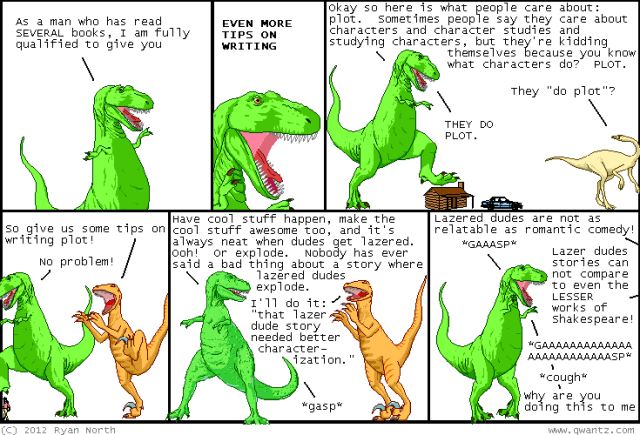
The plot vs character debate

The plot versus character debate is an old one.  Here’s a modern take on it:

Character vs plot qwantz Dinosaur Comic 2157 - image 2

Qwantz.com, Dinosaur Comics, “March 6th, 2012 – awesome fun times!” Comic 2157

I love Dinosaur Comics (www.qwantz.com).  They make their point, they make it concisely, and they have dinosaurs!

Yes, this post was unfinished for a long time. “Finished, it will be!” I said in a Yoda voice. (Use your imaginations, folks.)

The point was basically, many authors toss up between focussing on character versus focussing on plot.

To read more about this, take a look at my post Storyboarding for plotters and pantsers. That post talks about why authors can only focus on either character or plot at any one time, and why we need to also work on the one that we’re not good at.


This post was written by TJ Withers-Ryan © 2012. Reblogging is highly encouraged as long as you credit me as the author.

Why do I write?

CI Foundation Units 2011: "I am creative because" / "I am not creative because"

CI Foundation Units 2011: “I am creative because” / “I am not creative because”

“Why do I create?”

I was always certain I would grow up to be a writer.   My first words were “book”, “sit” and “read”.   There’s something about curling up with a good story and getting totally immersed in another world.

When I was four I discovered that it was possible to write one’s own stories!   (Imagine!)

This became a part of my identity – what do I like to do?   “I write stories.”

I’m not the only one creating things into the void as part of a search for meaning.   Some say the very meaning of life is “to create a connection between our inner depths and the outer world” (Kant, 1982, quoted in Ventegodt et al, 2003, 4).


Everyone has their reasons...

“Why are you creative?” from KKB101 lecture, 2011, QUT

Continue reading