Book review: Devotions that start and finish my day

My life verse, decorated by me using old wrapping paper (I recycle!). Was stuck up on my wall at the office - now it's stuck on our wall at home, right next to the front door. Last thing I see when I'm heading out? God's reminder.

My life verse, decorated by me using old wrapping paper (I recycle!). Was stuck up on my wall at the office – now it’s stuck on our wall at home, right next to the front door. Last thing I see when I’m heading out? God’s reminder.

As you know, my faith is a big part of who I am. But what do I do when I am faced with a spiritual drought?

The Bible is filled with amazing stories, inspiring messages … but I don’t find it easy to read it every day. (I do read a bit of it every day, but that’s because of discipline, not because the book of Amos fills with me great joy.) But we still need to be filled with God’s truth, so where can we go to find that inspiration?

Devotional books – books filled with a Bible verse for each day followed by an observation on that verse or a practical application for it – have always been useful to me during those dry stretches.

Today I thought I’d review some of the devotionals that I’ve worked through over the past three years – especially since a bunch of them are on sale this week!

Each of these books were helpful, but definitely in different ways and for different seasons. I’ve never found a ‘one-spiritual-thought-fits-all’ devotional. I hope you see some in the list that might help you grow closer to God.

My NIV Couples' Devotional Bible and my favourite coffee mug

My NIV Couples’ Devotional Bible and my favourite coffee mug

Continue reading

An ode to Terry Pratchett and the only gift a writer ever needs

Terry Pratchett.  Image source: Robin Matthews, Camera Press, via Daily Mail UK

Terry Pratchett.
Image source: Robin Matthews, Camera Press, via Daily Mail UK

One of my favourite authors of all time, prolific and gifted fantasy satire author Terry Pratchett, passed away last week. It hit me suddenly; I realised I had missed my chance. I wished I could have written to him before he moved on, to thank him for how he changed my writing, my life.

“You are a wonderful writer. Your books live in two and a half whole shelves of my largest bookcase because I enjoy rereading them so much. Thank you for your clever characters who made me think about the world differently. Thank you for your involving plots and your hilarious sense of humour, which gave me another world to live in on grey days.”

I know I’m just one fangirl of many. He’s such a famous author that I know he must get stacks of fan mail every day, from emails to postcards (“Terry, here I am at the edge of the Disc!”). By the time he died at 66 years old, he’d written 70 novels, including the 40-novel Discworld series that I loved so much.

But I still wish that I’d been able to express my gratitude to him in some small way – for me, not for him.

That day I made sure I didn’t miss out on other opportunities. I wrote two letters to authors at the publishing house where I work, whose novels are currently being copy-edited (an arduous process in which you question every word choice). I’d read the first or second drafts of their manuscripts in preparation for promoting their work and loved – simply loved – the writing and the characters. I’m not a crier, but I cried over the happy ending of one of them, sitting there at my desk in the marketing office.

So I wrote and told them, “I loved your book. It moved me greatly and I feel inspired to go out and do something about it. Your theme is one I’ve seen in real life and it thrilled me to see someone put it into words so accurately and with such real emotion.”

And I learned a big lesson.

Your encouragement is the best gift you can give a fellow writer.

Continue reading

Open letter to the doubting writer

I wrote this email to a client last month and they said it had to be shared, so here is an edited version of that note. I hope it encourages you as it did them.


60 Once upon a time on typewriter - bigstock_story_2226743_2 from Tamika Christy

Image source: Tamika Christy


Dear doubting writer,

No worries, don’t stress. Panic is a normal part of the writing (and a vital part of the editing) process; no doubt you know that already.

I wouldn’t have quoted on your book if I didn’t see in it the potential to be a truly worthy book. I’m not saying the book is perfect; that’s why editing is a good idea. But you’ve already got my vote of confidence.

There’s no one with a gun to your head to get this book out ASAP. No matter when it arrives, people will be thrilled ecstatically to read it.

But you know what, even if you look at your book and think “eh, it’s still not perfect”, I was reading another book today and came across this quote:

“the woods would be very silent
if no birds sang there
except those that sang best”
– Henry van Dyke

Continue reading

Narrative Therapy: Hear from the author of ‘How I rescued my brain’

At the Perth Writers Festival THIS SATURDAY (21 Feb 2015), you can hear David Roland speak about his book How I Rescued My Brain (Scribe) and how structured life writing (and narrative therapy) can lead to emotional resolution by turning subconscious memories into conscious concepts.

I’m still learning about this topic, but I’m reading a psychology book at the moment about it, Narrative Therapy by Gene Combs and Jill Freedman, so this post will have a follow-up post once I’ve really got my head around it. Normally I wouldn’t post about a topic until I’d done my research, but I figured if you want to go to his event and find out more, you need to know it’s happening now!

Narrative therapy is when you write about an event that has happened to you so that you can see the whole “story arc” of what happened for yourself and gain a better understanding of why it happened, how it came about, and what the resolution of it is.

I picked the Combs/Freedman book up for the concept itself. Closure! Resolution! A better way to think about ourselves and our life events. It’s useful for lots of things. Trauma patients, depressed patients, or people who want to write so they can see the bigger picture they want for their life – e.g. when they’re going through a big change like changing careers or having kids.

For us creators, it’s important because narrative therapy helps us to think outside the box of our own circular thinking, and that thought-stretching can give us better neural plasticity, as David Roland’s book (below) tells us. And neural plasticity means the ability to think of new ideas and be more creative, so it’s worth finding out more about… (Plus narrative writing therapy is good practise at writing a cohesive story!)

David Roland says “life writing” (narrative therapy) enables us to do lots of different useful things, from moving through difficult times, to heightening positive experiences, to learning new things. In his case, Roland had to relearn things his brain already knew, but had forgotten, after he had what doctors assumed was a “stroke-like” event. He was a forensic psychologist who ended up in the emergency ward one day with no idea how he got there.  His book is the story of his neurological breakdown and how he made his remarkable cognitive recovery. You can read more about the book here and buy tickets to his talk here.

Image source: Caroline Leaf

Image source: Caroline Leaf

And for a distinctly Christian perspective on neural plasticity, check out Switched On My Brain by Caroline Leaf PhDhttp://www.koorong.com/search/product/switch-on-your-brain-caroline-leaf/9780801016240.jhtml  According to researchers, the vast majority (about three quarters) of the illnesses that plague us today are a direct result of our thought life and the toxins that are caused by negative thinking patterns. What we think about definitely affects both our emotional and our physical health. Dr Leaf tells us how to think positive while keeping mindfully focussed on God, not just “empty” meditation. This book has been highly recommended by a few people now, so it is next on my to-read list!


This post was written by TJ Withers-Ryan, (C) 2015. Reblogging is always highly encouraged, as long as you cite me as the author.

Adorkable literary proposals to read over Valentine’s Day, part 2

The Valentine’s Nebula, a gift from God to let you know you are loved by someone much bigger than you are!  Image source: NASA’s Hubble Space Telescope

The Valentine’s Nebula, a gift from God to let you know you are loved by someone much bigger than you are!
Image source: NASA’s Hubble Space Telescope

Happy Valentine’s Day to all of you – taken, searching, or happily single alike! You all have the same value and worth in God’s eyes; you are not defined by your marital status. Has to be said.

Now on to fun things – my favourite proposal stories! Most of them are in books, some of them are in real life, but I’ll just be sharing the literary ones today. 😉

  1. Anne Elliot and Frederick Wentworth in Persuasion by Jane Austen – the second, successful one

Secret confession – not actually a 100% Pride and Prejudice fangirl. My secret love is the best love story of all time – Persuasion!

We don’t usually get to hear the words in Jane Austen’s successful proposals. She delights in describing the unsuccessful proposals, the ones that get rejected so eloquently. But when the answer is going to be yes, then Austen only brings the scene to the point of “they both understand each other, at last!” or at least “they both realise their affection for the other” and then moves right along to “My father happily gave his consent and we were married in spring.”

The exception is here, in Persuasion. We get to read the full proposal because she gives us one of the most romantic letters of all time, which has since featured on coffee mugs, book bags and T-shirts, etc.

Written by Frank Wentworth to his beloved Anne Elliot, it describes his feelings in a way that is still expressed today, although in different words, by men everywhere who approach the woman they love unsure whether she’ll say yes or no:

“I can listen no longer in silence. I must speak to you by such means as are within my reach. You pierce my soul. I am half agony, half hope. Tell me not that I am too late, that such precious feelings are gone for ever. I offer myself to you again with a heart even more your own than when you almost broke it, eight years and a half ago. Dare not say that man forgets sooner than woman, that his love has an earlier death. I have loved none but you. Unjust I may have been, weak and resentful I have been, but never inconstant. You alone have brought me to Bath. For you alone, I think and plan. Have you not seen this? Can you fail to have understood my wishes? I had not waited even these ten days, could I have read your feelings, as I think you must have penetrated mine. I can hardly write. I am every instant hearing something which overpowers me. You sink your voice, but I can distinguish the tones of that voice when they would be lost on others. Too good, too excellent creature! You do us justice, indeed. You do believe that there is true attachment and constancy among men. Believe it to be most fervent, most undeviating, in
F. W.”

Continue reading

Adorkable literary proposals to read over Valentine’s Day, part 1

Read this story today and had to share because it is just aDORKable!

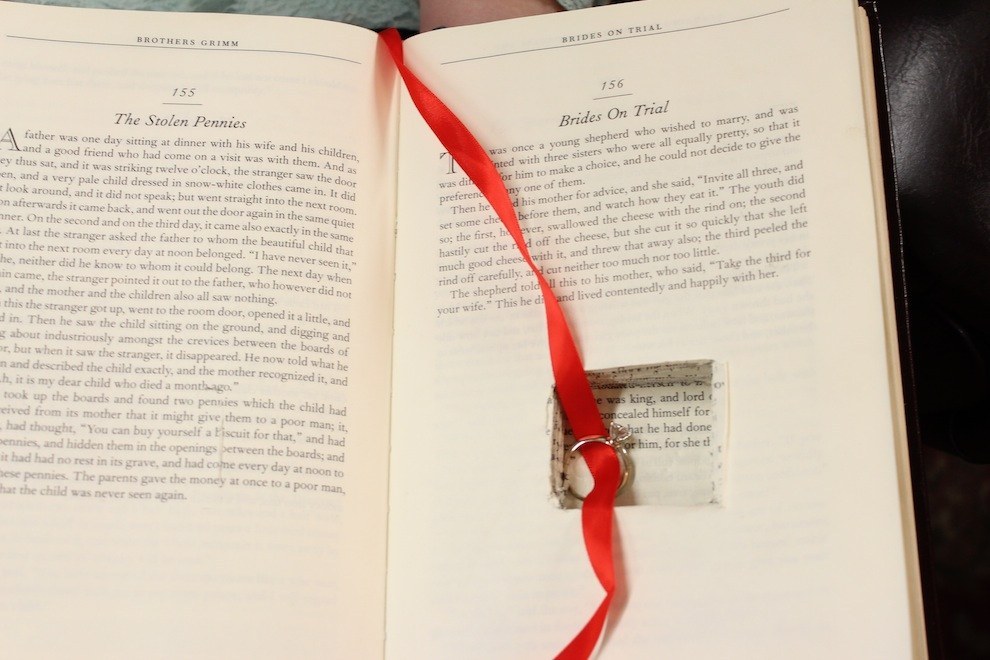
Britt Burgeson, 26, met Daniel O’Duffy, 25, when they were both students at the University of Notre Dame. Image source: Krystie Yandoli, BuzzFeed

Britt Burgeson, 26, met Daniel O’Duffy, 25, when they were both students at the University of Notre Dame.
Image source: Krystie Yandoli, BuzzFeed

A proposal in a bookstore! Lovely! The ring was hidden in a book! ^

Read the full story here: http://www.buzzfeed.com/krystieyandoli/this-couples-bookstore-proposal-is-every-book-lovers-dream#.wu3dOzd92

I don’t usually approve of this sort of public proposal, because GOODNESS, what incredible peer pressure to say yes! I wouldn’t want to be forced to have such a humongous moment in front of a bunch of strangers.

On the other hand, if you’re going to do it in public, hopefully you’ve been together so long that you know each other well and have talked about the idea of marriage together already, so it wouldn’t be a shock.

Wait till tomorrow when I’ll share my faves from literary proposals in classic (and not so classic) books.


This post was written by TJ Withers-Ryan (C) 2015. Reblogging is highly encouraged as long as you credit me as the author of this text.

Foreshadowing: Do you know what’s coming?

'Okay class, is there anyone else who does not understand the term foreshadowing?' Image source: Artist Dan Reynolds via Cartoon Stock

Image source: Artist Dan Reynolds via Cartoon Stock

One of my number one pet peeves is people who don’t indicate. Are they trying to kill me? They change lanes by swerving in front of me without warning; they stop in the middle of the road for no reason and then suddenly turn onto a side road without warning; they merge towards me without warning.

It’s no joke. Indicating saves lives.

In literary terms, foreshadowing is the equivalent of indicating.

Maybe it’s not life-saving, but it is a useful device. You’re telling your reader – without telling them – what’s coming. So it’s a bit more subtle than “Hey, I’m turning left now.” You’re hinting. You’re insinuating. You’re planting a thought. “Hey, maybe I’ll merge. Sometime soon. You might see it coming, you might not.”

Isn’t that cheating?

No. There’s two valid main reasons for foreshadowing:

  1. To build anticipation in your reader. What’s going to happen next? Ooh, dramatic tension!
  2. To make strange or unlikely events seem credible. The reader is mentally prepared for it to happen because someone already hinted that it could

So, how to do it well? How to do it poorly? It all depends on which method of foreshadowing you’re using.

Continue reading

Read all about it: Write Around Queensland short story I edited and my reviews of other stories (50th post!)

Historic moment: Just realised this is the 50th post on my blog! Woohoo!
Thanks for joining me for the ride. 🙂

Maya’s signature look of excitement  Image source: Chelsea Anne Photography / Becuo Images

Maya’s signature look of excitement
Image source: Chelsea Anne Photography / Becuo Images
(http://chelseaanne.com/personal/mayas-signature-look/)

After 12 months of working and waiting for the 2014 Write Around Queensland anthology, today is the day!

You might remember that I said there would be some book reviews coming. Well, you also get to read the story that I edited in the eBook of the anthology – for free!

Continue reading

Is that a real word?

P.L. Travers (played by Emma Thompson) with the scriptwriter and songwriters responsible for the Disney movie version of Mary Poppins

P.L. Travers (played by Emma Thompson) with the scriptwriter and songwriters responsible for the Disney movie version of Mary Poppins
Image Source: Robert Deluce

Richard Sherman: Room here for everyone / Gather around / The constable’s “responstible”! / Now how does that sound?

P.L. Travers: No, no, no, no, no! “Responstible” is not a word!

Richard Sherman: We made it up.

P.L. Travers: Well, un-make it up.

Richard Sherman: [Hides sheet music of ‘Supercalifragilisticexpialidocious’.]

Scene from Saving Mr. Banks


I edited a book once by an author who used words wrong.  Just plain wrong.  There’s no other way to say it.

He said “supposably” and “supposedly” (those aren’t real words!) instead of “suspiciously” (which is not even close to the meaning of those “words”).

When I called him on it the first few times, he got all snippy.  “How do you know what’s a real word and what isn’t?  I hear people saying ‘supposably’ all the time.”

“Um, that’s my job.  I get paid to know correct grammar and spelling.  And that’s honestly not a real word.  And even if it was a real word now, which it’s not, it’s still not a word that a peasant would have used in medieval times.”

Continue reading

Being a promiscuous reader: Brisbane Writers Festival

Stack of books with spines open

Image source: Resource Freak

“I’m a very promiscuous reader; I believe we should take all kinds of genres to bed with us.” ― Lauren Beukes

Lauren Beukes

Lauren Beukes
(pronounced something like “Beeyohkes”)
Image source: The Audio Bookstore

Today I went to my first Brisbane Writers Festival session and thoroughly enjoyed it!  Lauren Beukes, South African author of science fiction and crime noir novels, says we should read everything we can get our hands on, no matter what genre we write for ourselves.  Here’s why…

Continue reading